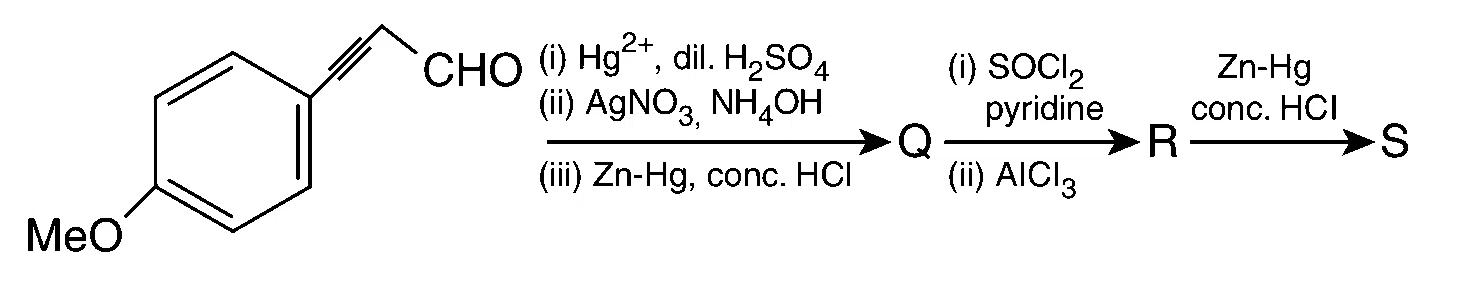
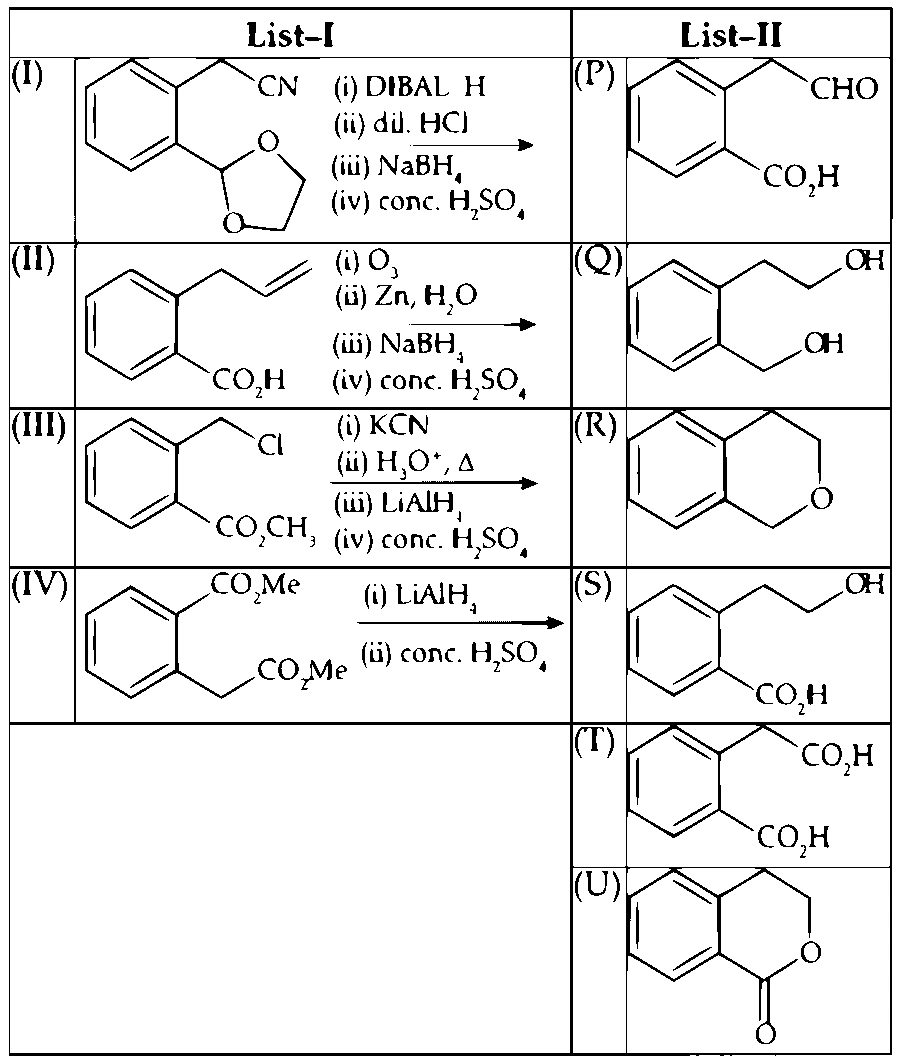
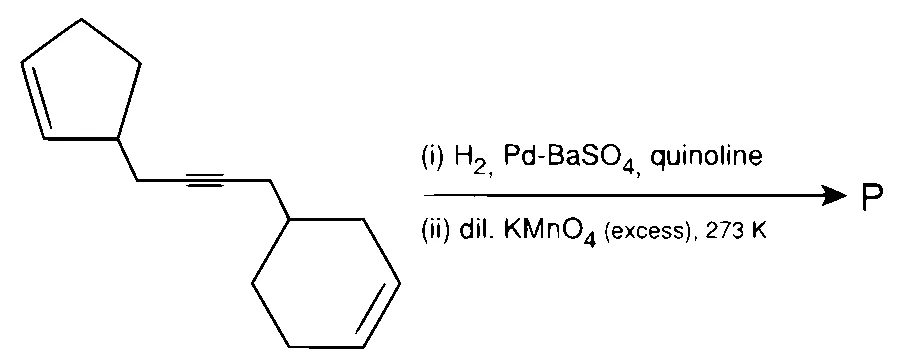
List-I includes starting materials and reagents of selected chemical reactions. List-II gives structures of compounds that may be formed as intermediate products and/or final products from the reactions of List-I.
Which of the following options has correct combination considering List-I and List-II?
is started in a closed cylinder under isothermal isochoric condition at an initial pressure of 1 atm. After Y 103 s, the pressure inside the cylinder is found to be 1.45 atm. If the rate constant of the reaction is 5 10-4s-1, assuming ideal gas behaviour, the value of Y is ...............
The cyanide process of gold extraction involves leaching out gold from its ore with CN in the presence of Q in water to form R. Subsequently, R is treated with T to obtain Au and Z. Choose the correct option(s).
The mole fraction of urea in an aqueous urea solution containing 900 g of water is 0.05. If the density of the solution is 1.2 g cm3, then molarity of urea solution is ................
(Given data : Molar masses of urea and water are 60 g mol1 and 18 g mol1, respectively)
The amount of water produced (in g) in the oxidation of 1 mole of rhombic sulphur by conc. HNO3 to a compound with the highest oxidation state of sulphur is ..............
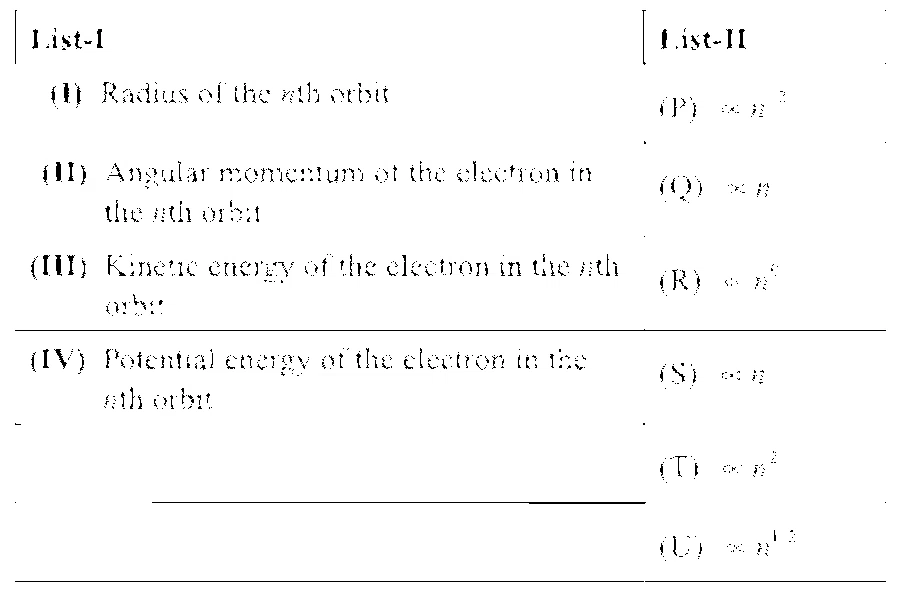
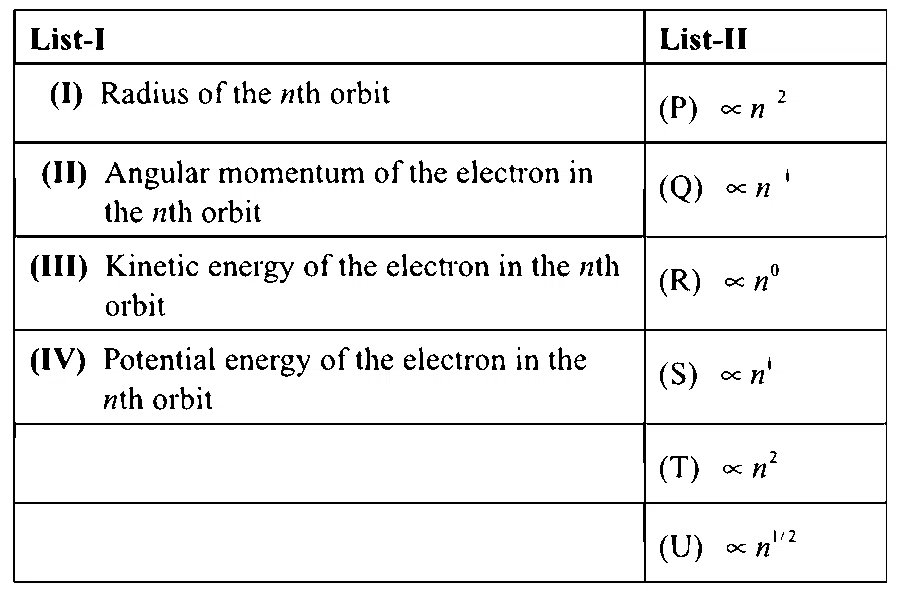
Consider the Bohr's model of a one-electron atom where the electron moves around the nucleus. In the following List-I contains some quantities for the nth orbit of the atom and List-II contains options showing how they depend on n.
Which of the following options has the correct combination considering List-I and List-II?
The ground state energy of hydrogen atom is 13.6 eV. Consider an electronic state of He+ whose energy, azimuthal quantum number and magnetic quantum number are 3.4 eV, 2 and 0, respectively.
Which of the following statement(s) is(are) true for the state ?
Consider the Bohr's model of a one-electron atom where the electron moves around the nucleus. In the following List-I contains some quantities for the nth orbit of the atom and List-II contains options showing how they depend on n.
Which of the following options has the correct combination considering List-I and List-II?