PracBee
Back

IIT-JEE 2012 Paper 2 Offline Question Paper

JEE Advanced · 8 Apr 2012 · Answers and step-by-step solutions

Paper PDF and print

Showing 25 of 60 questions · Page 1 of 3

1IIT-JEE 2012 Paper 2 Offline
MCQM+4 / -22012Physics

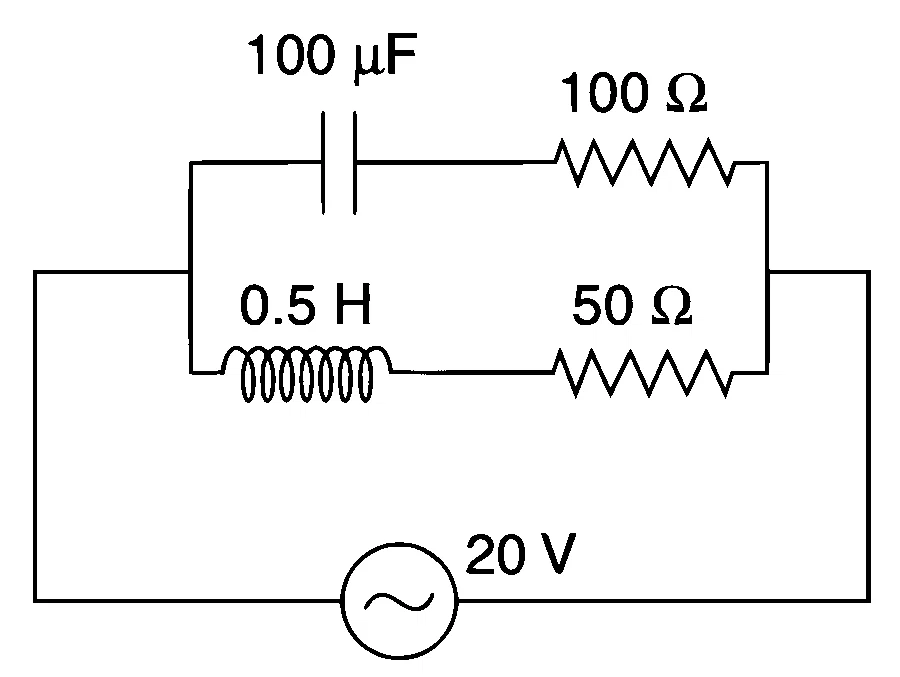
In the given circuit, the AC source has ω = 100 rad/s. Considering the inductor and capacitor to be ideal, the correct choice(s) is(are)

IIT-JEE 2012 Paper 2 Offline Physics - Alternating Current Question 13 English

2IIT-JEE 2012 Paper 2 Offline
MCQ+3 / -12012Physics

The β-decay process, discovered in around 1900, is basically the decay of a neutron (n). In the laboratory, a proton (p) and an electron (e−) are observed as the decay products of the neutron. Therefore, considering the decay of a neutron as a two-body decay process, it was predicted theoretically that the kinetic energy of the electron should be a constant. But experimentally, it was observed that the electron kinetic energy has continuous spectrum. Considering a three-body decay process, that is, n → p + e− + v―e, around 1930, Pauli explained the observed electron energy spectrum. Assuming the anti-neutrino (v―e) to be massless and possessing negligible energy, and the neutron to be at rest, momentum and energy conservation principles are applied. From this calculation, the maximum kinetic energy of the electron is 0.8 × 10⁶ eV. The kinetic energy carried by the proton is only the recoil energy.

What is the maximum energy of the anti-neutrino?

3IIT-JEE 2012 Paper 2 Offline
MCQ+3 / -12012Physics

The β-decay process, discovered in around 1900, is basically the decay of a neutron (n). In the laboratory, a proton (p) and an electron (e−) are observed as the decay products of the neutron. Therefore, considering the decay of a neutron as a two-body decay process, it was predicted theoretically that the kinetic energy of the electron should be a constant. But experimentally, it was observed that the electron kinetic energy has continuous spectrum. Considering a three-body decay process, that is, n → p + e− + v―e, around 1930, Pauli explained the observed electron energy spectrum. Assuming the anti-neutrino (v―e) to be massless and possessing negligible energy, and the neutron to be at rest, momentum and energy conservation principles are applied. From this calculation, the maximum kinetic energy of the electron is 0.8 × 10⁶ eV. The kinetic energy carried by the proton is only the recoil energy.

If the anti-neutrino had a mass of 3 eV/c2 (where c is the speed of light) instead of zero mass, what should be the range of the kinetic energy, K, of the electron?
4IIT-JEE 2012 Paper 2 Offline
MCQ+4 / -12012Physics
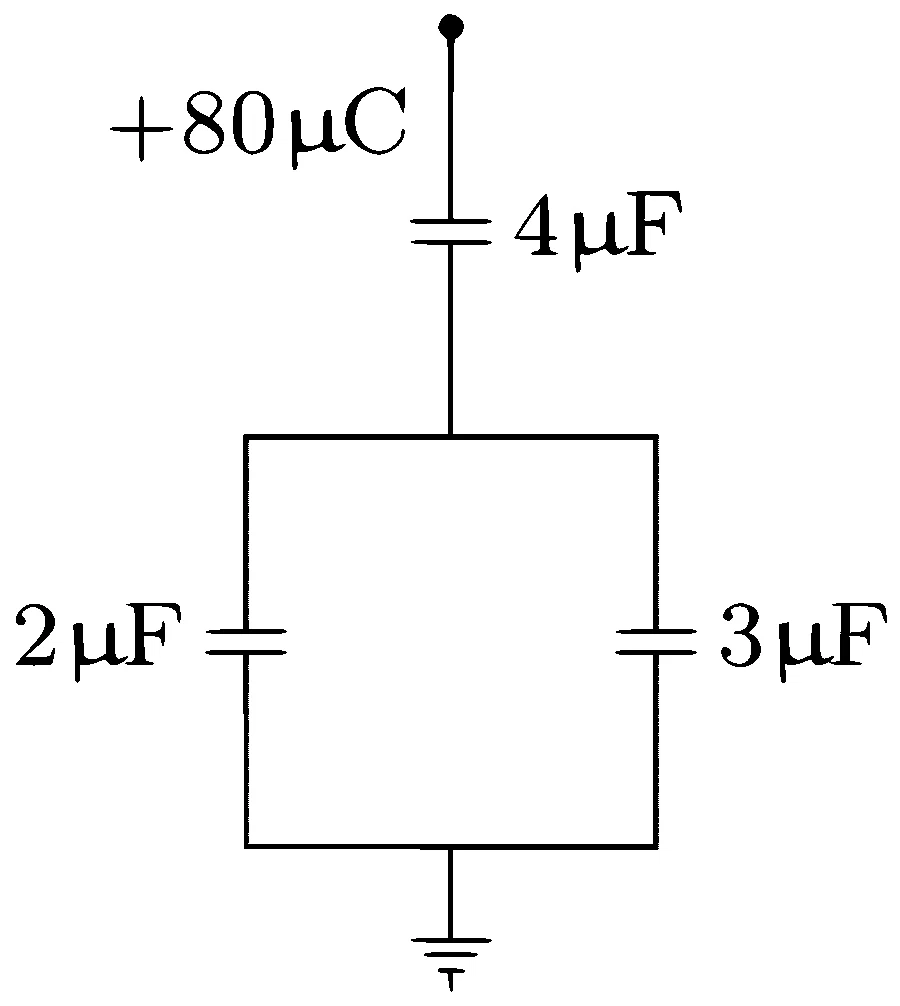
In the given circuit, a charge of +80 μC is given to the upper plate of the 4 μF capacitor. Then in the steady state, the charge on the upper plate of the 3 μF capacitor is

IIT-JEE 2012 Paper 2 Offline Physics - Capacitor Question 21 English
5IIT-JEE 2012 Paper 2 Offline
MCQM+4 / -22012Physics

A current carrying infinitely long wire is kept along the diameter of a circular wire loop, without touching it, the correct statement(s) is(are)
6IIT-JEE 2012 Paper 2 Offline
MCQM+4 / -12012Physics
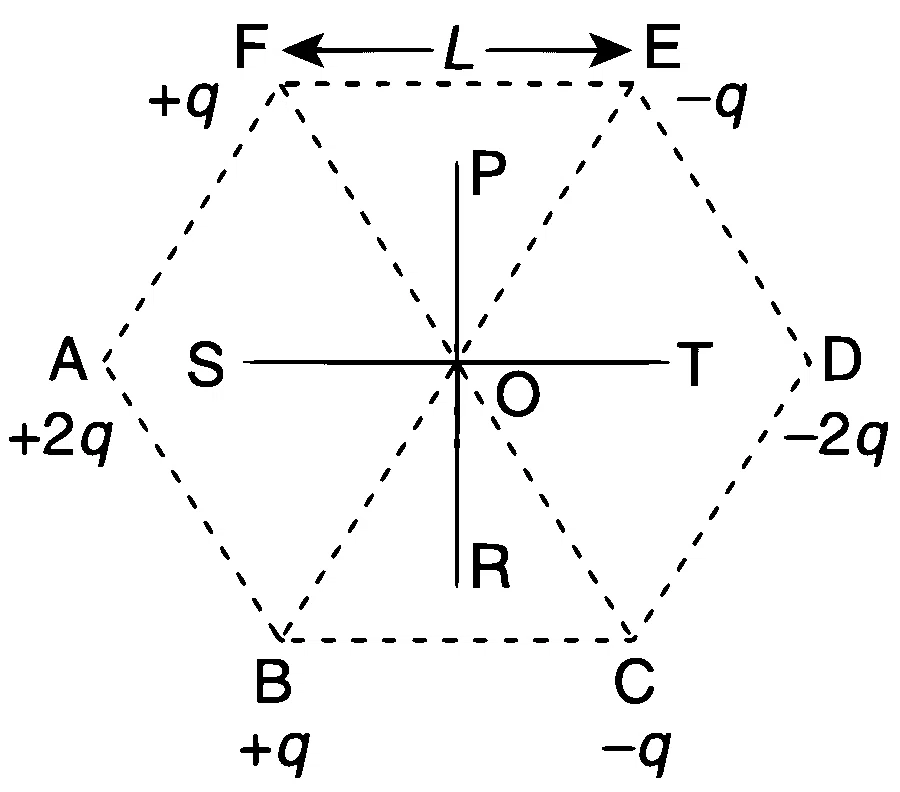
Six point charges are kept at the vertices of a regular hexagon of side L and center O, as shown in the figure. Given that K=14πε0qL2, which of the following statement(s) is (are) correct ?

IIT-JEE 2012 Paper 2 Offline Physics - Electrostatics Question 56 English
7IIT-JEE 2012 Paper 2 Offline
MCQ+3 / -12012Physics

Most materials have the refractive index, n > 1. So, when a light ray from air enters a naturally occurring material, then by Snell's law, sin⁡θ1sin⁡θ2=n2n1, it is understood that the refracted ray bends towards the normal. But it never emerges on the same side of the normal as the incident ray. According to electromagnetism, the refractive index of the medium is given by the relation n=(cv)=±εrμr, where c is the speed of electromagnetic waves in vacuum, v its speed in the medium, εr and μr, are the relative permittivity and permeability of the medium, respectively.


In normal materials, both εr and μr , are positive, implying positive n for the medium. When both εr and μr are negative, one must choose the negative root of n. Such negative refractive index materials can now be artificially prepared and are called meta-materials. They exhibit significantly different optical behaviour, without violating and physical laws. Since n is negative, it results in a change in the direction of propagation of the refracted light. However, similar to normal materials, the frequency of light remains unchanged upon refraction even in meta-materials.

For light incident from air on a meta-material, the appropriate ray diagram is

8IIT-JEE 2012 Paper 2 Offline
MCQ+3 / -12012Physics

Most materials have the refractive index, n > 1. So, when a light ray from air enters a naturally occurring material, then by Snell's law, sin⁡θ1sin⁡θ2=n2n1, it is understood that the refracted ray bends towards the normal. But it never emerges on the same side of the normal as the incident ray. According to electromagnetism, the refractive index of the medium is given by the relation n=(cv)=±εrμr, where c is the speed of electromagnetic waves in vacuum, v its speed in the medium, εr and μr, are the relative permittivity and permeability of the medium, respectively.


In normal materials, both εr and μr , are positive, implying positive n for the medium. When both εr and μr are negative, one must choose the negative root of n. Such negative refractive index materials can now be artificially prepared and are called meta-materials. They exhibit significantly different optical behaviour, without violating and physical laws. Since n is negative, it results in a change in the direction of propagation of the refracted light. However, similar to normal materials, the frequency of light remains unchanged upon refraction even in meta-materials.

Choose the correct statement.

9IIT-JEE 2012 Paper 2 Offline
MCQM+4 / -12012Physics
Two spherical planets P and Q have the same uniform density r, masses MP and MQ and surface
areas A and 4A respectively. A spherical planet R also has uniform density r and its mass is (MP
+ MQ). The escape velocities from the planets P, Q and R are VP, VQ and VR, respectively. Then
10IIT-JEE 2012 Paper 2 Offline
MCQ+3 / -0.752012Physics
Two moles of ideal helium gas are in a rubber balloon at 30oC. The balloon is fully expandable
and can be assumed to require no energy in its expansion. The temperature of the gas in the balloon is slowly changed to 35oC. The amount of heat required in raising the temperature is
nearly (take R = 8.31 J/mol.K)
11IIT-JEE 2012 Paper 2 Offline
MCQ+3 / -12012Physics

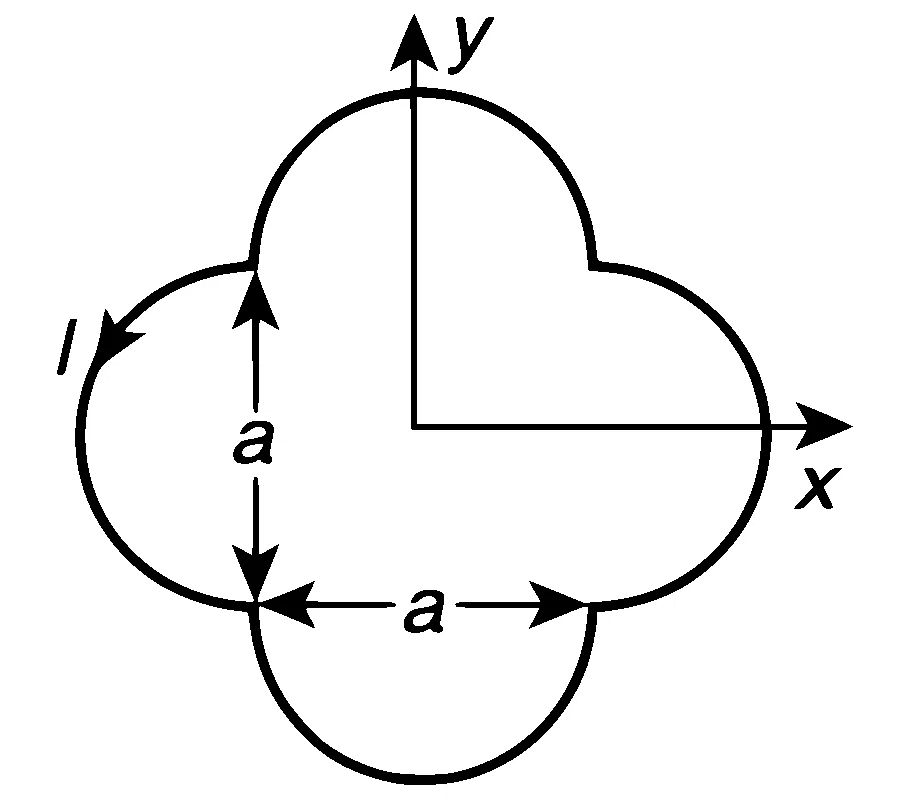
A loop carrying current l lies in the xy-plane as shown in the figure. The unit vector k^ is coming out of the plane of the paper. The magnetic moment of the current loop is


IIT-JEE 2012 Paper 2 Offline Physics - Magnetism Question 25 English

12IIT-JEE 2012 Paper 2 Offline
MCQ+3 / -12012Physics

An infinite long hollow conducting cylinder with inner radius R/2 and outer radius R carries a uniform current density along its length. The magnitude of the magnetic field, |B→| as a function of the radial distance r from the axis is best represented by

13IIT-JEE 2012 Paper 2 Offline
MCQ+3 / -0.752012Physics
A thin uniform cylindrical shell, closed at both ends, is partially filled with water. It is floating
vertically in water in half-submerged state. If ρc is the relative density of the material of the shell
with respect to water, then the correct statement is that the shell is
14IIT-JEE 2012 Paper 2 Offline
MCQ+3 / -12012Physics

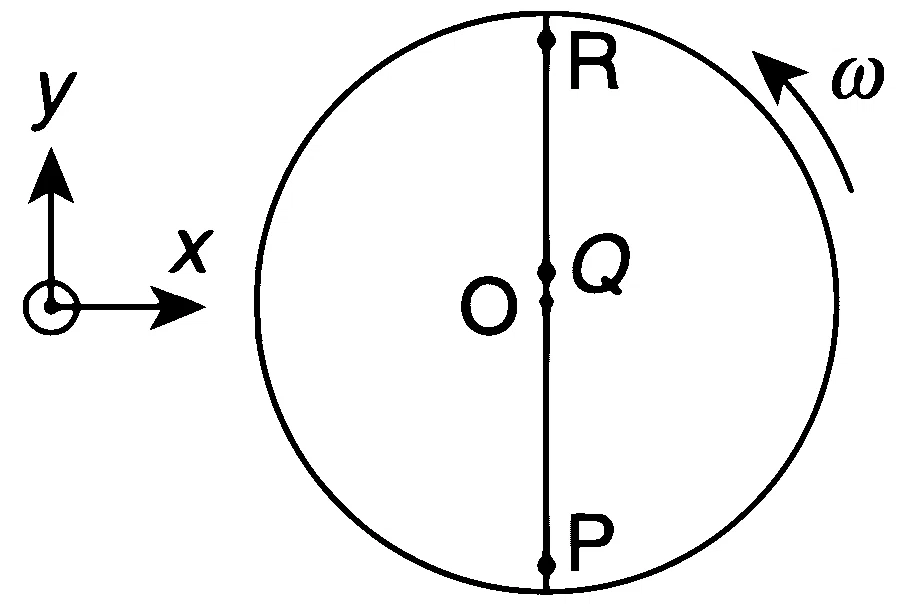
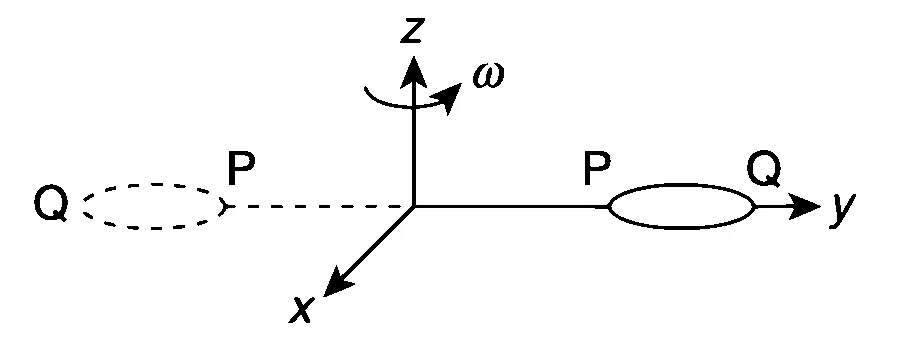
The general motion of a rigid body can be considered to be a combination of (i) a motion of its centre of mass about an axis, and (ii) its motion about an instantaneous axis passing through the centre of mass. These axes need not be stationary. Consider, for example, a thin uniform disc welded (rigidly fixed) horizontally at its rim to a massless stick, as shown in the figure. When the disc-stick system is rotated about the origin on a horizontal frictionless plane with angular speed ω, the motion at any instant can be taken as a combination of (i) a rotation of the centre of mass of the disc about the z-axis, and (ii) a rotation of the disc through an instantaneous vertical axis passing through its centre of mass (as it seen from the changed orientation of points P and Q). Both these motions have the same angular speed ω in this case.

IIT-JEE 2012 Paper 2 Offline Physics - Rotational Motion Question 41 English Comprehension 1


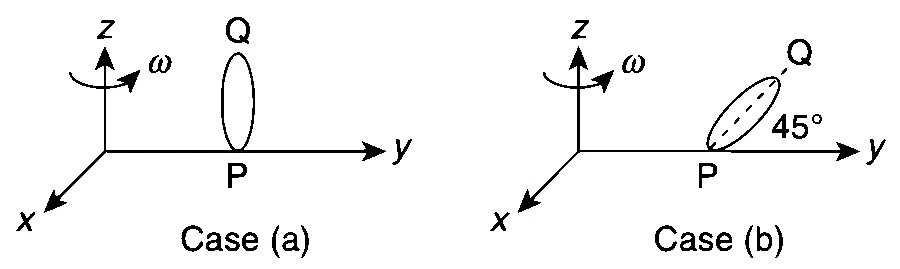
Now consider two similar systems as shown in the figure.


Case (a) : The disc with its face vertical and parallel to x-z axis;


Case (b) : The disc with its face making an angle of 45∘ with xy-plane and its horizontal diameter parallel to x-axis.


In both the cases, the disc is welded at point P, and the systems are rotated with constant angular speed ω about the z-axis.

IIT-JEE 2012 Paper 2 Offline Physics - Rotational Motion Question 41 English Comprehension 2

Which of the following statements about the instantaneous axis (passing through the centre of mass) is correct?

15IIT-JEE 2012 Paper 2 Offline
MCQ+3 / -12012Physics

The general motion of a rigid body can be considered to be a combination of (i) a motion of its centre of mass about an axis, and (ii) its motion about an instantaneous axis passing through the centre of mass. These axes need not be stationary. Consider, for example, a thin uniform disc welded (rigidly fixed) horizontally at its rim to a massless stick, as shown in the figure. When the disc-stick system is rotated about the origin on a horizontal frictionless plane with angular speed ω, the motion at any instant can be taken as a combination of (i) a rotation of the centre of mass of the disc about the z-axis, and (ii) a rotation of the disc through an instantaneous vertical axis passing through its centre of mass (as it seen from the changed orientation of points P and Q). Both these motions have the same angular speed ω in this case.


IIT-JEE 2012 Paper 2 Offline Physics - Rotational Motion Question 39 English Comprehension 1


Now consider two similar systems as shown in the figure.


Case (a) : The disc with its face vertical and parallel to x-z axis;


Case (b) : The disc with its face making an angle of 45∘ with xy-plane and its horizontal diameter parallel to x-axis.


In both the cases, the disc is welded at point P, and the systems are rotated with constant angular speed ω about the z-axis.


IIT-JEE 2012 Paper 2 Offline Physics - Rotational Motion Question 39 English Comprehension 2

Which of the following statements regarding the angular speed about the instantaneous axis (passing through the centre of mass) is correct?
16IIT-JEE 2012 Paper 2 Offline
MCQM+4 / -12012Physics
Two solid cylinders P and Q of same mass and same radius start rolling down a fixed inclined
plane from the same height at the same time. Cylinder P has most of its mass concentrated near
its surface, while Q has most of its mass concentrated near the axis. Which statement(s) is(are)
correct?
17IIT-JEE 2012 Paper 2 Offline
MCQ+3 / -0.752012Physics
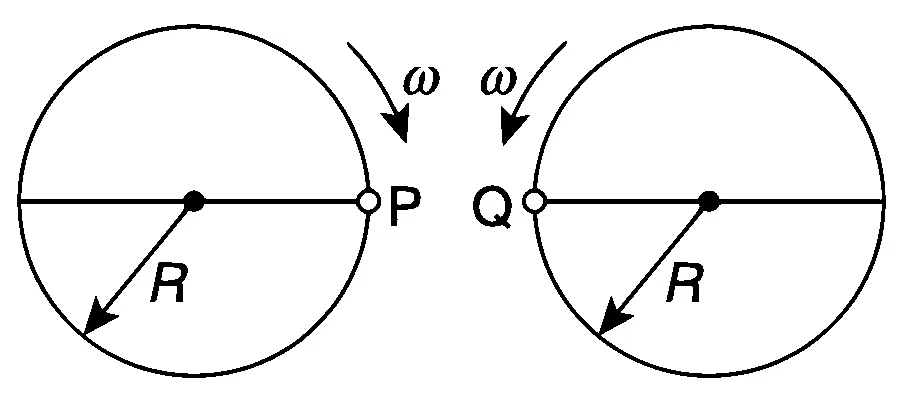
Two identical discs of same radius R are rotating about their axes in
opposite directions with the same constant angular speed ω. The
discs are in the same horizontal plane. At time t = 0, the points P
and Q are facing each other as shown in the figure. The relative
speed between the two points P and Q is vr. In one time period (T)
of rotation of the discs, vr as a function of time is best represented
by
IIT-JEE 2012 Paper 2 Offline Physics - Rotational Motion Question 72 English
18IIT-JEE 2012 Paper 2 Offline
MCQM+4 / -12012Physics
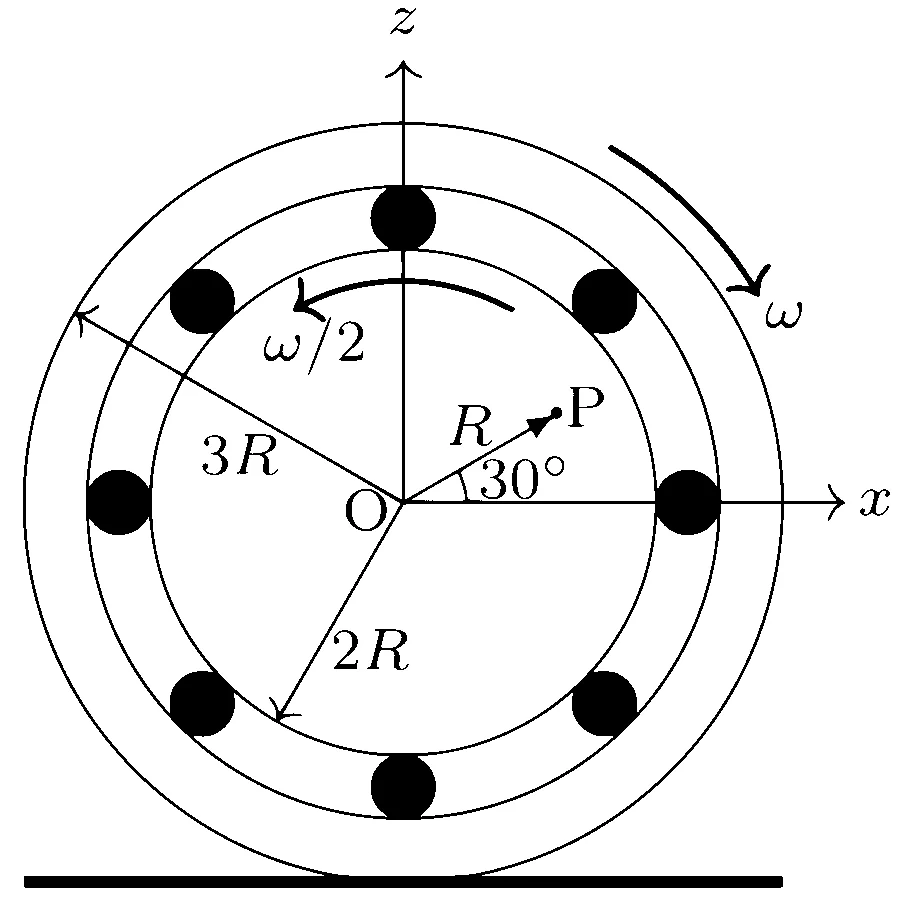
The figure shows a system consisting of (i) a ring of outer radius 3R rolling clockwise without
slipping on a horizontal surface with angular speed ω and (ii) an inner disc of radius 2R rotating
anti-clockwise with angular speed ω2. The ring and disc are separated by frictionless ball
bearings. The point P on the inner disc is at a distance R from the origin, where OP makes an
angle of 30∘ with the horizontal. Then with respect to the horizontal surface,

IIT-JEE 2012 Paper 2 Offline Physics - Rotational Motion Question 68 English
19IIT-JEE 2012 Paper 2 Offline
MCQ+3 / -0.752012Physics
Consider a disc rotating in the horizontal plane with a constant angular speed ω about its centre
O. The disc has a shaded region on one side of the diameter and an unshaded region on the
other side as shown in the figure. When the disc is in the orientation as shown, two pebbles P
and Q are simultaneously projected at an angle towards R. The velocity of projection is in the y - z
plane and is same for both pebbles with respect to the disc. Assume that (i) they land back on
the disc before the disc has completed 18 rotation, (ii) their range is less than half the disc radius,
and (iii) ω remains constant throughout. Then


IIT-JEE 2012 Paper 2 Offline Physics - Rotational Motion Question 71 English
20IIT-JEE 2012 Paper 2 Offline
MCQ+3 / -0.752012Physics
A student is performing the experiment of resonance Column. The diameter of the column tube is
4 cm. The frequency of the tuning fork is 512 Hz. The air temperature is 38oC in which the speed
of sound is 336 m/s. The zero of the meter scale coincides with the top end of the Resonance
Column tube. When the first resonance occurs, the reading of the water level in the column is
21IIT-JEE 2012 Paper 2 Offline
MCQ+3 / -12012Chemistry

The major product H of the given reaction sequence is


CH3−CH2−CO−CH3⟶C―NG⟶Heat95%H2SO4H

22IIT-JEE 2012 Paper 2 Offline
MCQ+3 / -12012Chemistry

The compound that undergoes decarboxylation most readily under mild condition is

23IIT-JEE 2012 Paper 2 Offline
MCQ+3 / -12012Chemistry

In the following reaction sequence, the compound J is an intermediate.


IIT-JEE 2012 Paper 2 Offline Chemistry - Aldehydes, Ketones and Carboxylic Acids Question 45 English Comprehension


J(C9H8O2) gives effervescence on treatment with NaHCO3 and a positive Baeyer's test.

The compound I is
24IIT-JEE 2012 Paper 2 Offline
MCQ+3 / -12012Chemistry

In the following reaction sequence, the compound J is an intermediate.


IIT-JEE 2012 Paper 2 Offline Chemistry - Aldehydes, Ketones and Carboxylic Acids Question 40 English Comprehension


J(C9H8O2) gives effervescence on treatment with NaHCO3 and a positive Baeyer's test.

The compound K is

25IIT-JEE 2012 Paper 2 Offline
MCQM+4 / -22012Chemistry

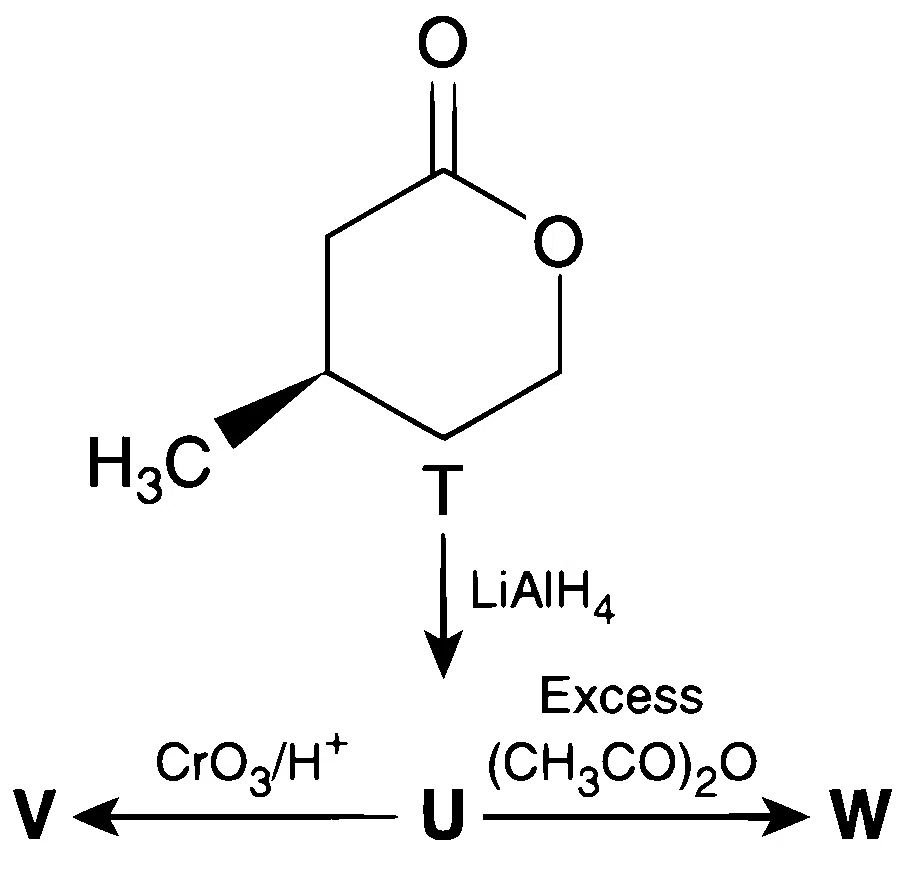
With reference to the scheme given, which of the given statement(s) about T, U, V and W is(are) correct?

IIT-JEE 2012 Paper 2 Offline Chemistry - Aldehydes, Ketones and Carboxylic Acids Question 43 English

More 2012 JEE Advanced papers