1IIT-JEE 2008 Paper 1 Offline
MCQM+4 / -22008Physics
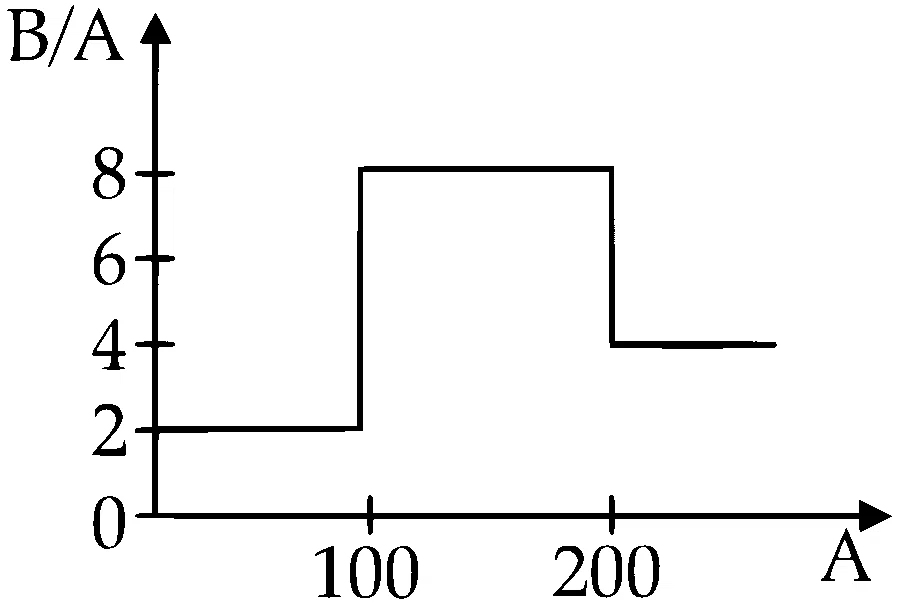
Assume that the nuclear binding energy per nucleon (B/A) versus mass number (A) is as shown in the figure. Use this plot to choose the correct choice(s) given below.

JEE Advanced · 13 Apr 2008 · Answers and step-by-step solutions
Showing 25 of 69 questions · Page 1 of 3
Assume that the nuclear binding energy per nucleon (B/A) versus mass number (A) is as shown in the figure. Use this plot to choose the correct choice(s) given below.
In a mixture of H - He
The quantum number n of the state finally populated in He
In a mixture of H - He
The wavelength of light emitted in the visible region by He
In a mixture of H - He
The ratio of the kinetic energy of the
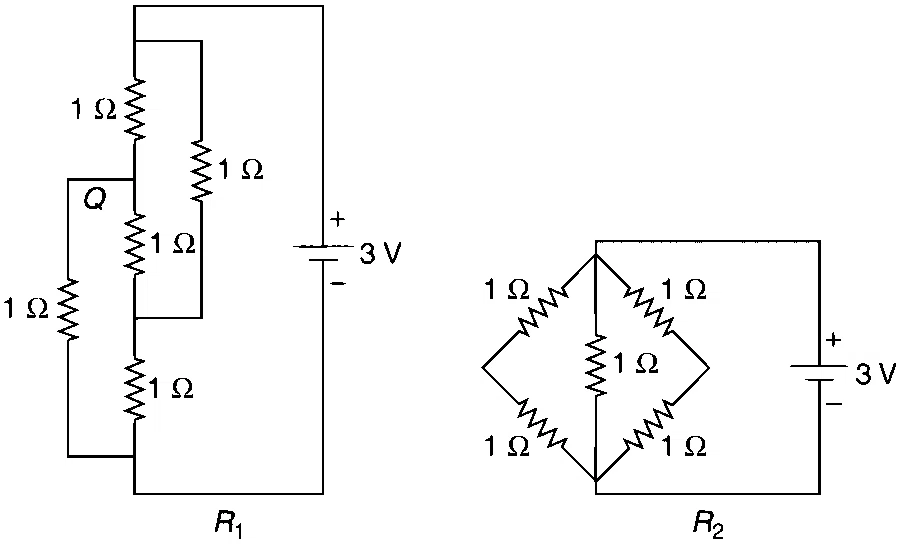
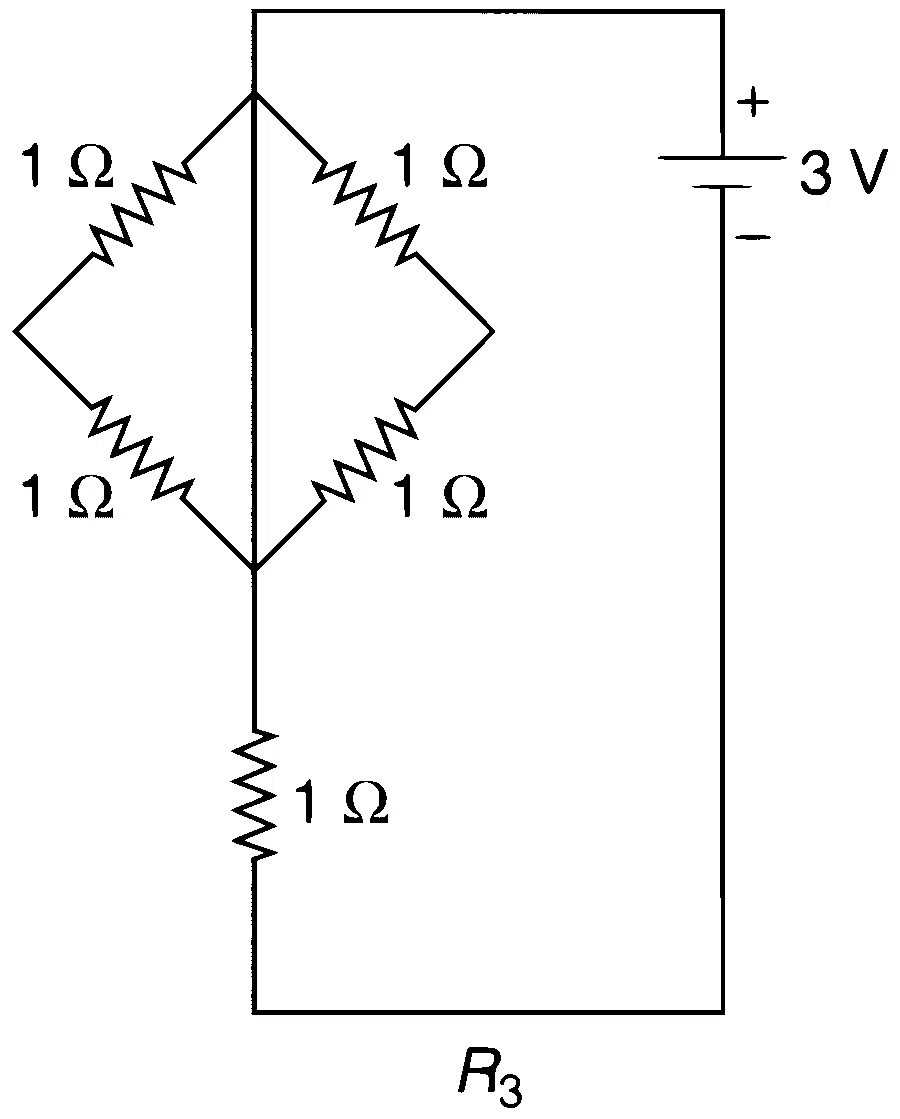
Figure shows three resistor configurations R1, R2 and R3 connected to 3 V battery. If the power dissipated by the configuration R1, R2 and R3 is P1, P2 and P3, respectively, then
STATEMENT - 1
In a Meter Bridge experiment, null point for an unknown resistance is measured. Now, the unknown resistance is put inside an enclosure maintained at a higher temperature. The null point can be obtained at the same point as before by decreasing the value of the standard resistance.
and
STATEMENT - 2
Resistance of a metal increases with increase in temperature.
Which one of the following statements is WRONG in the context of X-rays generated from a X-ray tube?
Two beams of red and violet colours are made to pass separately through a prism (angle of the prism is 60
A spherically symmetric gravitational system of particles has a mass density
Where
STATEMENT - 1
An astronaut in an orbiting space station above the Earth experiences weightlessness.
and
STATEMENT - 2
An object moving around the Earth under the influence of Earth's gravitational force is in a state of 'free-fall'.
An ideal gas is expanding such that PT
Two balls, having linear momenta
A small block of mass M moves on a frictionless surface of an inclined plane, as shown in figure. The angle of the incline suddenly changes from 60
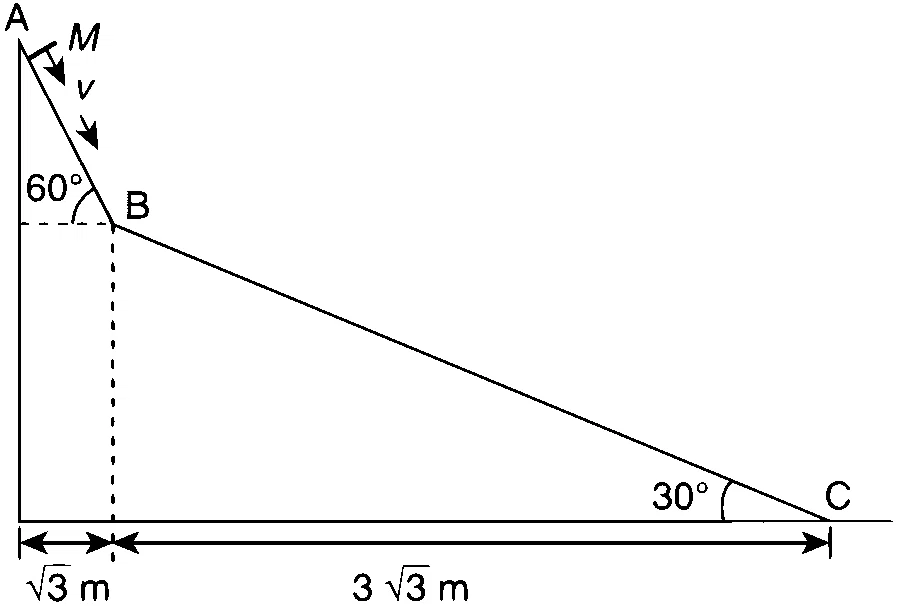
If collision between the block and the incline is completely elastic, then the vertical (upward) component of the velocity of the block at point B, immediately after it strikes the second incline is
A small block of mass M moves on a frictionless surface of an inclined plane, as shown in figure. The angle of the incline suddenly changes from 60
The speed of the block at point B immediately after it strikes the second incline is
A small block of mass M moves on a frictionless surface of an inclined plane, as shown in figure. The angle of the incline suddenly changes from 60
The speed of the block at point C, immediately before it leaves the second incline is
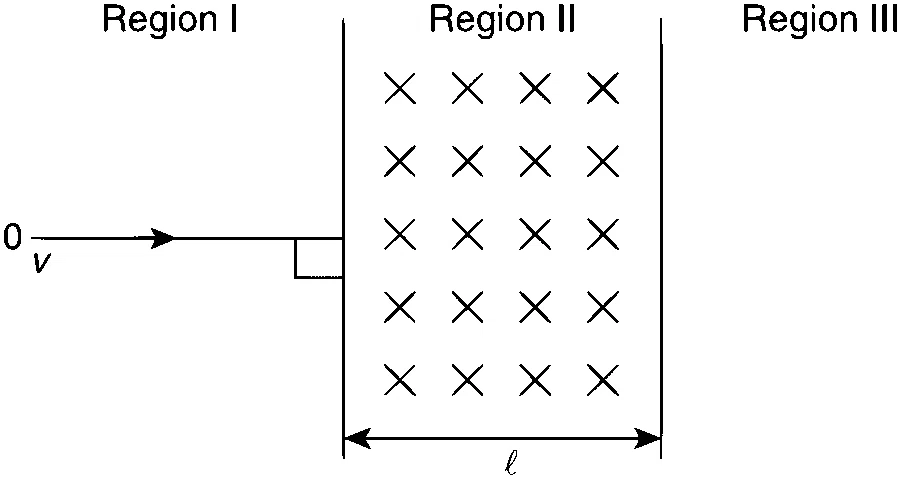
A particle of mass m and charge q, moving with velocity v enters Region II normal to the boundary as shown in the figure. Region II has a uniform magnetic field B perpendicular to the plane of the paper. The length of the Region II is
STATEMENT - 1 :
The stream of water flowing at high speed from a garden hose pipe tends to spread line a fountain when held vertically up, but tends to narrow down when held vertically down.
and
STATEMENT - 2 :
In any steady flow of an incompressible fluid, the volume flow rate of the fluid remains constant.
A small spherical monoatomic ideal gas bubble
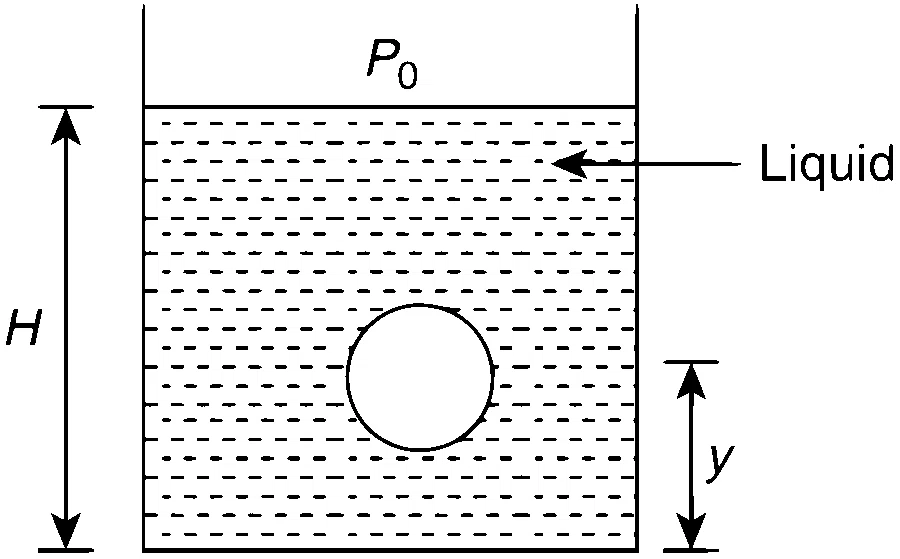
As the bubble moves upwards, besides the buoyancy force the following forces are acting on it
A small spherical monoatomic ideal gas bubble
When the gas bubble is at a height y from the bottom, its temperature is :
A small spherical monoatomic ideal gas bubble
The buoyancy force acting on the gas bubble is (Assume R is the universal gas constant)
STATEMENT - 1 :
Two cylinders, one hollow (metal) and the other solid (wood) with the same mass and identical dimensions are simultaneously allowed to roll without slipping down an inclined plane from the same height. The hollow cylinder will reach the bottom of the inclined plane first.
and
STATEMENT - 2 :
By the principle of conservation of energy, the total kinetic energies of both the cylinders are identical when they reach the bottom of the incline.
Student I, II and III perform an experiment for measuring the acceleration due to gravity (g) using a
simple pendulum. They use different length of the pendulum and/or record time for different number
of oscillations. The observations area shown in the table.
Least count for length = 0.1 cm
Least count for time = 0.1 s
| Student | Length of the pendulum (cm) | No. of oscillations (n) | Total time for(n) oscillations (s) | Time periods (s) |
|---|---|---|---|---|
| I | 64.0 | 8 | 128.0 | 16.0 |
| II | 64.0 | 4 | 64.0 | 16.0 |
| III | 20.0 | 4 | 36.0 | 9.0 |
If EI, EII and EIII are the percentage errors in g, i.e.,
In a Young's double slit experiment, the separation between the two slits is d and the wavelength of the light is
In the following reaction sequence, products I, J and L are formed. K represents a reagent.
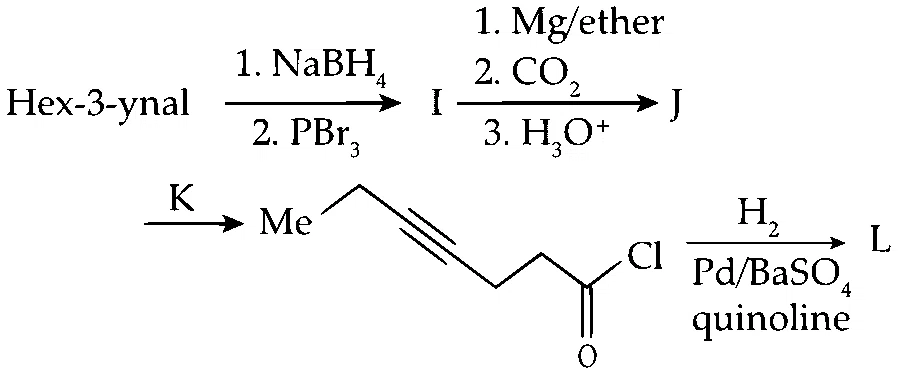
The structure of the product I is :
In the following reaction sequence, products I, J and L are formed. K represents a reagent.
The structure of compounds J and K, respectively, are: