A coil has resistance 30 ohm and inductive reactance 20 ohm at 50 Hz frequency. If an ac source, of 200 volt, 100 Hz, is connected across the coil, the current in the coil will be
Two radioactive nuclei P and Q, in a given sample decay into a stable nucleus R. At time t = 0. number of P species are 4 N0 and that of Q are N0. Half -life of P (for conversion to R) is 1 minute where as that of Q is 2 minutes. Initially there are no nuclei of R present in the sample. When number of nuclei of P and Q are equal, the number of nuclei of R present in the sample would be
An electron in the hydrogen atom jumps from excited state n to the ground state. The wavelength so emitted illuminates a photosensitive material having work function 2.75 eV. If the stopping potential of the photoelectron is 10 V, then the value of n is
A thermocouple of negligible resistance produces an e.m.f. of 40 µV/ºC in the linear range of temperature. A galvanometer of resistance 10 ohm whose sensitivity is 1 µA/division, is employed with the thermocouple. The smallest value of temperature difference that can be detected by the system will be
The threshold frequency for a photosensitive metal is 3.3 1014 Hz. If light of frequency 8.2 1014 Hz is incident on this metal, the cut- off voltage for the photoelectron emission is nearly
The electric potential V at any point (x, y, z), all in metres in space is given by V = 4x2 volt. The electric field at the point (1, 0, 2) in volt/meter, is
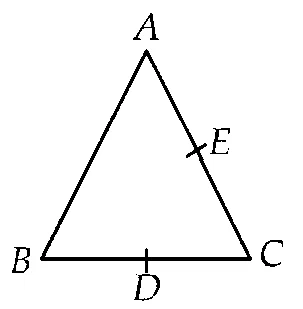
Three charges, each +q, are placed at the corners of an isosceles triangle ABC of sides BC and AC, 2. D and E are the mid points of BC and CA. The work done in taking a charge Q from D to E is
A thin prism of angle 15o made of glass of refractive index 1 = 1.5 is combined with another prism of glass of refractive index 2 = 1.75. The combination of the prisms produces dispersion without deviation. The angle of the second prism should be
A converging beam of rays is incident on a diverging lens. Having passed through the lens the rays intersect at a point 15 cm from the lens on the opposite side. If the lens is removed the point where the rays meet will move 5 cm closer to the lens. The focal length of the lens is
A particle of mass m is thrown upwards from the surface of the earth, with a velocity u. The mass and the radius of the earth are, respectively, M and R. G is gravitational constant and g is acceleration due to gravity on the surface of the earth. The minimum value of u so that the particle does not return back to earth, is
A particle of mass M is situated at the centre of a spherical shell of same mass and radius a. The magnitude of the gravitational potential at a point sutuated at a/2 distance from the centre, will be :
A mass of diatomic gas at a pressure of 2 atmospheres is compressed adiabatically so that its temperature rises from 27oC to 927oC. The pressure of the gas in the final state is
A conveyor belt is moving at a constant speed of 2 ms1. A box is gently dropped on it. The coefficient of friction between them is = 0.5. The distance that the box will move relativce to belt before coming to rest on it, taking g = 10 m s2,, is
A short bar magnet of magnetic moment 0.4 J T1 is placed in a uniform magnetic field of 0.16 T. The magnet is in stable equilibrium when the potential energy is
A projectile is fired at an angle of 45o with the horizontal. Elevation angle of the projectile at its highest point as seen from the point of projection, is
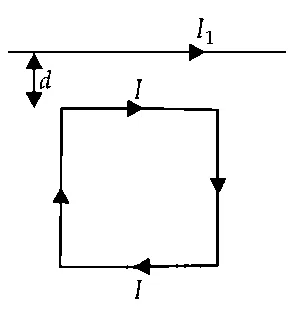
A square loop, carrying a teady current , is placed in a horizontal plane near a long straight conductor carrying a steady current 1 at a distance d from the conductor as shown in figure. The loop will experience
Charge q is uniformly spread on a thin ring of radius R. The ring rotates about its axis with a uniform frequency Hz. The magnitude of magnetic induction at the center of the ring is
A galvanometer of resistance, G, is shunted by a resistance S ohm. To keep the main current in the circuit unchanged, the resistance to be put in series with the galvanometer is
Two particles are oscillating along two close parallel straight lines side by side, with the same frequency and amplitudes. They pass each other, moving in opposite directions when their displacement is half of the amplitude. The mean positions of the two particles lie on a straight line perpendicular to the paths of the two particles. The phase difference is
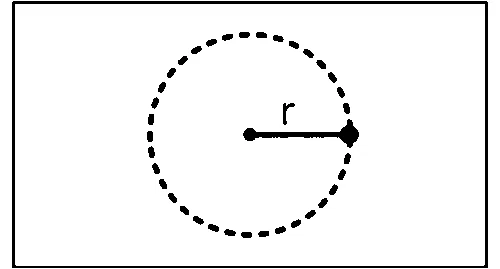
A small mass attached to a string rotates on a frictionless table top as shown. If the tension in the string is increased by pulling the string causing the radius of the circular motion to decrease by a factor of 2, the kinetic energy of the mass will