PracBee
Back

AIPMT 2009 Chemistry Questions

NEET · 10 May 2009 · Answers and step-by-step solutions

Paper PDF and print

PDF and print include all subjects in this paper.

Showing 25 of 50 Chemistry questions · Page 1 of 2

1AIPMT 2009
MCQ+4 / -12009Chemistry
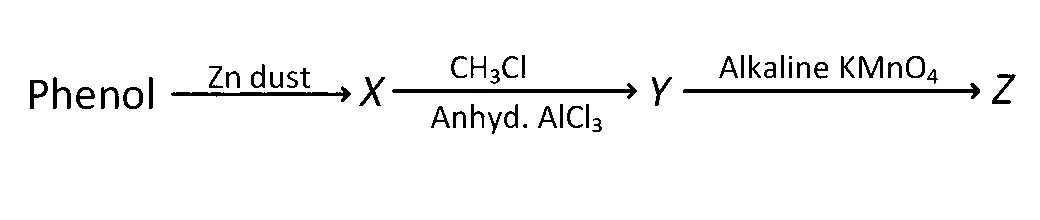
Consider the following reaction :


AIPMT 2009 Chemistry - Alcohol, Phenols and Ethers Question 30 English

the product Z is
2AIPMT 2009
MCQ+4 / -12009Chemistry
Consider the following reaction :


AIPMT 2009 Chemistry - Alcohol, Phenols and Ethers Question 32 English

the product Z is
3AIPMT 2009
MCQ+4 / -12009Chemistry
HOCH2CH2OH on heating with periodic acid gives
4AIPMT 2009
MCQ+4 / -12009Chemistry
Trichloroacetaldehyde, CCl3CHO reacts with chlorobenzene in presence of sulphuric acid and produces
5AIPMT 2009
MCQ+4 / -12009Chemistry
Propionic acid with Br2/P yields a dibromo product. Its structure would be
6AIPMT 2009
MCQ+4 / -12009Chemistry
Which of the following hormones contains iodine?
7AIPMT 2009
MCQ+4 / -12009Chemistry
The segment of DNA which acts as the instrumental manual for the synthesis of the protein is
8AIPMT 2009
MCQ+4 / -12009Chemistry
What is the dominant intermolecular force or bond that must be overcome in converting liquid CH3OH to a gas?
9AIPMT 2009
MCQ+4 / -12009Chemistry
According to MO theory which of the lists ranks the nitrogen species in terms of increasing bond order ?
10AIPMT 2009
MCQ+4 / -12009Chemistry
In which of the following molecules/ions BF3, NO2−, NH2− and H2O, the central atom is sp2 hybridised?
11AIPMT 2009
MCQ+4 / -12009Chemistry
The dissociation constants for acetic acid and HCN at 25oC are 1.5 × 10⁻⁵ and 4.5 × 10⁻¹⁰ respectively. The equilibrium constant for the equilibrium

CN− + CH3COOH ⇌ HCN + CH3COO− would be
12AIPMT 2009
MCQ+4 / -12009Chemistry
In the reaction,

BrO3(aq)− + 5Br(aq)− + 6H+ → 3Br2(l) + 3H2O(l).

The rate of appearance of bromine (Br2) is related to rate of disappearance of bromide ions as
13AIPMT 2009
MCQ+4 / -12009Chemistry
For the reaction A + B → products, it is observed that


(i)  on doubling the initial concentration of A only, the rate of reaction is also doubled and

(ii)  on doubling the initial concentration of both A and B, there is a change by a factor of 8 in the rate of the reaction.


The rate of this reaction is given by
14AIPMT 2009
MCQ+4 / -12009Chemistry
For the reaction, N2 + 3H2 → 2NH3, if

d[NH3]dt = 2 × 10⁻⁴ mol L−1 s−1,

the value of −d[H2]dt would be
15AIPMT 2009
MCQ+4 / -12009Chemistry
Half-life period of a first order reaction is 1386 seconds. The specific rate constant of the reaction is
16AIPMT 2009
MCQ+4 / -12009Chemistry
Which one of the following is employed as a tranquilizer?
17AIPMT 2009
MCQ+4 / -12009Chemistry
Which of the following does not show optical isomerism?


(en = ethylenediamine)
18AIPMT 2009
MCQ+4 / -12009Chemistry
Out of TiF62−, CoF63−, Cu2Cl2 and NiCl42− (Z of Ti = 22, Co = 27, Cu = 29, Ni = 28) the colourless species are
19AIPMT 2009
MCQ+4 / -12009Chemistry
Which of the following complex ions is expected to absorb visible light?

(At. nos. Zn = 30, Sc = 21, Ti = 22, Cr = 24)
20AIPMT 2009
MCQ+4 / -12009Chemistry
Which one of the elements with the following outer orbital configurations may exhibit the largest number of oxidation states?
21AIPMT 2009
MCQ+4 / -12009Chemistry
Al2O3 is reduced by electrolysis at low potentials and high currents. If 4.0 × 10⁴ amperes of current is passed through molten Al2O3 for 6 hours, what mass of aluminium is product? (Assume 100% current efficiency, at mass of Al = 27 g mol−1).
22AIPMT 2009
MCQ+4 / -12009Chemistry
Given :

(i)   Cu2+ + 2e− → Cu,  Eo = 0.337 V

(ii)  Cu2+ + e− → Cu+,  Eo = 0.153 V

Electrode potential, Eo for the reaction,

Cu+ + e− → Cu,  will be
23AIPMT 2009
MCQ+4 / -12009Chemistry
The equivalent conductance of M/32 solution of a weak monobasic acid is 8.0 mho cm2 and at infinite dilution is 400 mho cm2. The dissociation constant of this acid is
24AIPMT 2009
MCQ+4 / -12009Chemistry
The energy absorbed by each molecule (A2) of a substance is 4.4 × 10⁻¹⁹ J and bond energy per molecule is 4.0 × 10⁻¹⁹ J. The kinetic energy of the molecule per atom will be

25AIPMT 2009
MCQ+4 / -12009Chemistry
Which of the following reactions is an example of nucleophilic substitution reaction?