126KCET 2026MCQ+1 / -02026MathematicsSaveFull page∑n=14(−1)2n⋅i2n=A2B−iC0DiCheck AnswerShow SolutionReveal with HintsNext
127KCET 2026MCQ+1 / -02026MathematicsSaveFull page∫a−6b−6f(x+6)dx is equal toA∫abf(x+6)dxB∫abf(x−6)dxC∫abf(x)dxD−∫abf(x)dxCheck AnswerShow SolutionReveal with HintsNext
128KCET 2026MCQ+1 / -02026MathematicsSaveFull pageOne of the possible functions f(x) which satisfies ∫−22f(x)dx=0 isAlog(2−x2+x)Bsin(2−x)C3x2−2x+1D2xtanxCheck AnswerShow SolutionReveal with HintsNext
129KCET 2026MCQ+1 / -02026MathematicsSaveFull pageSum of the squares of the order and degree (if defined) of a differential equation 2y′+(y′′)2=y′′−3 isA3B20C8D16Check AnswerShow SolutionReveal with HintsNext
130KCET 2026MCQ+1 / -02026MathematicsSaveFull page∫xf(x)dx+f(x)2=0, then f(x) is equal toAe−2xBe2xCe−x2Dex2Check AnswerShow SolutionReveal with HintsNext
131KCET 2026MCQ+1 / -02026MathematicsSaveFull pageIntegrating factor of the differential equation (1+x2)dydx+xy=1 isA1+x2B12log(1+x2)Cx1+x2D1+x2Check AnswerShow SolutionReveal with HintsNext
132KCET 2026MCQ+1 / -02026MathematicsSaveFull pageThe second order derivative of cos−1(4x3−3x) with respect to cos−1(2x2−1), where 12<x<1 isA0B−11−x2C32D−32Check AnswerShow SolutionReveal with HintsNext
133KCET 2026MCQ+1 / -02026MathematicsSaveFull pageIf f(x)=sin−1(2x1+x2), then f′(12)=A85B58C45D0Check AnswerShow SolutionReveal with HintsNext
134KCET 2026MCQ+1 / -02026MathematicsSaveFull pageIf y=tanx+y3, then dydx=Atanx3y2−1Bsec2x3y−1Ctanx3y−1Dsec2x3y2−1Check AnswerShow SolutionReveal with HintsNext
135KCET 2026MCQ+1 / -02026MathematicsSaveFull pageIf xy3=(x+y)n and xdydx−y=0, then n=A1B65C56D49Check AnswerShow SolutionReveal with HintsNext
136KCET 2026MCQ+1 / -02026MathematicsSaveFull pagef(x)=(x−1)2 for x≥1, g(x) is a function whose graph is the reflection of the graph of f(x) in the line y=x, then g(x) isA−x+1Bx−1Cx+1Dx−1Check AnswerShow SolutionReveal with HintsNext
137KCET 2026MCQ+1 / -02026MathematicsSaveFull pageThe domain of the function x−79−x isA[7,9]B[7,9)C(7,9]D(7,9)Check AnswerShow SolutionReveal with HintsNext
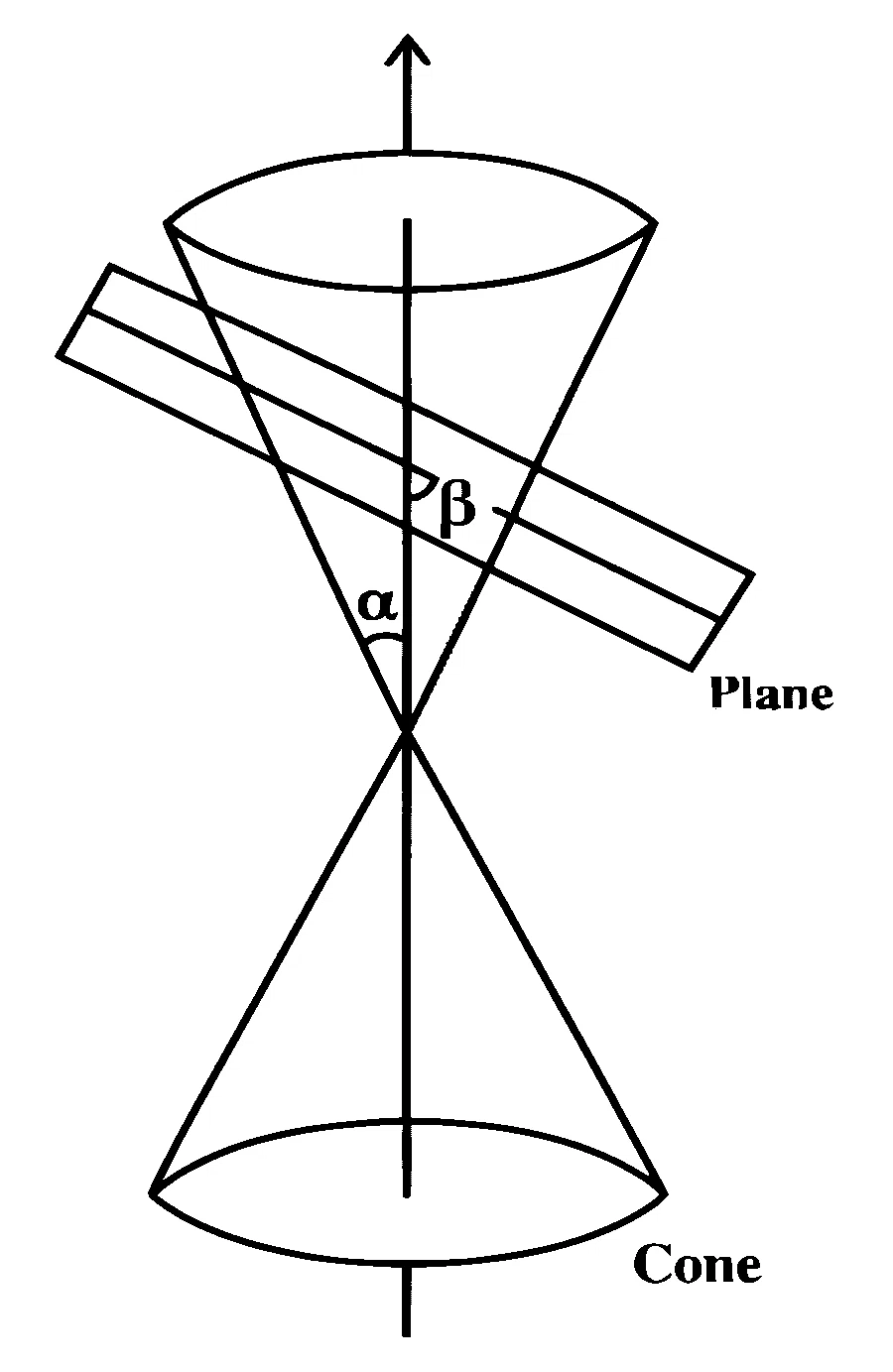
138KCET 2026MCQ+1 / -02026MathematicsSaveFull pageIn the figureStatement-I: When α>β≥0, the section is hyperbolaStatement-II: When β>90∘, the section is ellipseWhich of the following is correct?AStatement I is true, Statement II is falseBStatement I is false, Statement II is trueCBoth the Statements are trueDBoth the Statements are falseCheck AnswerShow SolutionReveal with HintsNext
139KCET 2026MCQ+1 / -02026MathematicsSaveFull page∫e−xlog2⋅2xdx=Alogx+CBx+CC1x+CDx22+CCheck AnswerShow SolutionReveal with HintsNext
140KCET 2026MCQ+1 / -02026MathematicsSaveFull pageIf 'n' is a natural number, then ∫sinnxcosn+2xdx=Atann−1xn−1+CBtannxn+CCtann+2xn+2+CDtann+1xn+1+CCheck AnswerShow SolutionReveal with HintsNext
141KCET 2026MCQ+1 / -02026MathematicsSaveFull pagetan−1(11+1⋅2)+tan−1(11+2⋅3)+…+tan−1(11+n(n+1))=Atan−1(nn+2)Btan−1(n+1n)Ctan−1(nn+1)Dtan−1(n+2n)Check AnswerShow SolutionReveal with HintsNext
142KCET 2026MCQ+1 / -02026MathematicsSaveFull pageIf sin−1x+sin−1y=π2, then x2 is equal toA1−y2B1−y2C−1−y2D1+y2Check AnswerShow SolutionReveal with HintsNext
143KCET 2026MCQ+1 / -02026MathematicsSaveFull pageIf f(x)={x2−1if x≥2x+1if x<2, then limx→1f(x)+limx→2f(x)=A3B5C7D9Check AnswerShow SolutionReveal with HintsNext
144KCET 2026MCQ+1 / -02026MathematicsSaveFull pageIf limx→3(x2−ax−3bx−3)=5, then a+b=A1B2C3D4Check AnswerShow SolutionReveal with HintsNext
145KCET 2026MCQ+1 / -02026MathematicsSaveFull pageIf f(x)={ax+7if x<13x−1if x=1bx+3if x>1 is continuous at x=1, thenAa=−5,b=2Ba=−5,b=−2Ca=5,b=−2Da=−5,b=8Check AnswerShow SolutionReveal with HintsNext
146KCET 2026MCQ+1 / -02026MathematicsSaveFull pageIn Linear Programming Problem (LPP), the objective function Z=ax+by has the same maximum value at two corner points. The number of points at which Zmax occurs isA1B2C0DInfinityCheck AnswerShow SolutionReveal with HintsNext
147KCET 2026MCQ+1 / -02026MathematicsSaveFull pageThe corner points of the feasible region determined by the system of linear constraints are (0,10),(5,5),(15,15),(0,20). Let z=px+qy where p,q>0. The relation between p and q, so that the maximum z occurs at both points (15,15) and (0,20) isAp=qBp=2qCq=2pDq=3pCheck AnswerShow SolutionReveal with HintsNext
148KCET 2026MCQ+1 / -02026MathematicsSaveFull pageThe solution of 3(x−1)≤2(x−3) isAx≤−3Bx≥−3Cx≤3Dx≥3Check AnswerShow SolutionReveal with HintsNext
149KCET 2026MCQ+1 / -02026MathematicsSaveFull pageThe area of the triangle with vertices (3,8),(−4,2) and (5,1) is P4, then the value of P isA612B261C122D1122Check AnswerShow SolutionReveal with HintsNext
150KCET 2026MCQ+1 / -02026MathematicsSaveFull pageIf A and B are invertible matrices of same order, then which of the following is not correct?AA⋅(adjA)=(adjA)⋅A=AIBA⋅(adjA)=(adjA)⋅A=|A|IC(AB)−1=B−1A−1D|A|≠0,|B|≠0Check AnswerShow SolutionReveal with Hints