1JEE Main 2026 (Online) 28th January Evening Shift
MCQ+4 / -12026Chemistry
The reactions which produce alcohol as the product are :
A.
B.
C.
D.
E.
Choose the correct answer from the options given below :

JEE Main · 28 Jan 2026 · Answers and step-by-step solutions
PDF and print include all subjects in this paper.
Showing 25 of 25 Chemistry questions · Page 1 of 1
The reactions which produce alcohol as the product are :
A.
B.
C.
D.
E.
Choose the correct answer from the options given below :
The correct order of acidic strength of the major products formed in the given reactions, is :
A.
B.
C.
D.
Choose the correct answer from the options given below :
Identify the correct statements :
The presence of –NO2 group in benzene ring
A. activates the ring towards electrophilic substitutions.
B. deactivates the ring towards electrophilic substitutions.
C. activates the ring towards nucleophilic substitutions.
D. deactivates the ring towards nucleophilic substitutions.
Choose the correct answer from the options given below :
The cyclic cations having the same number of hyperconjugation are :
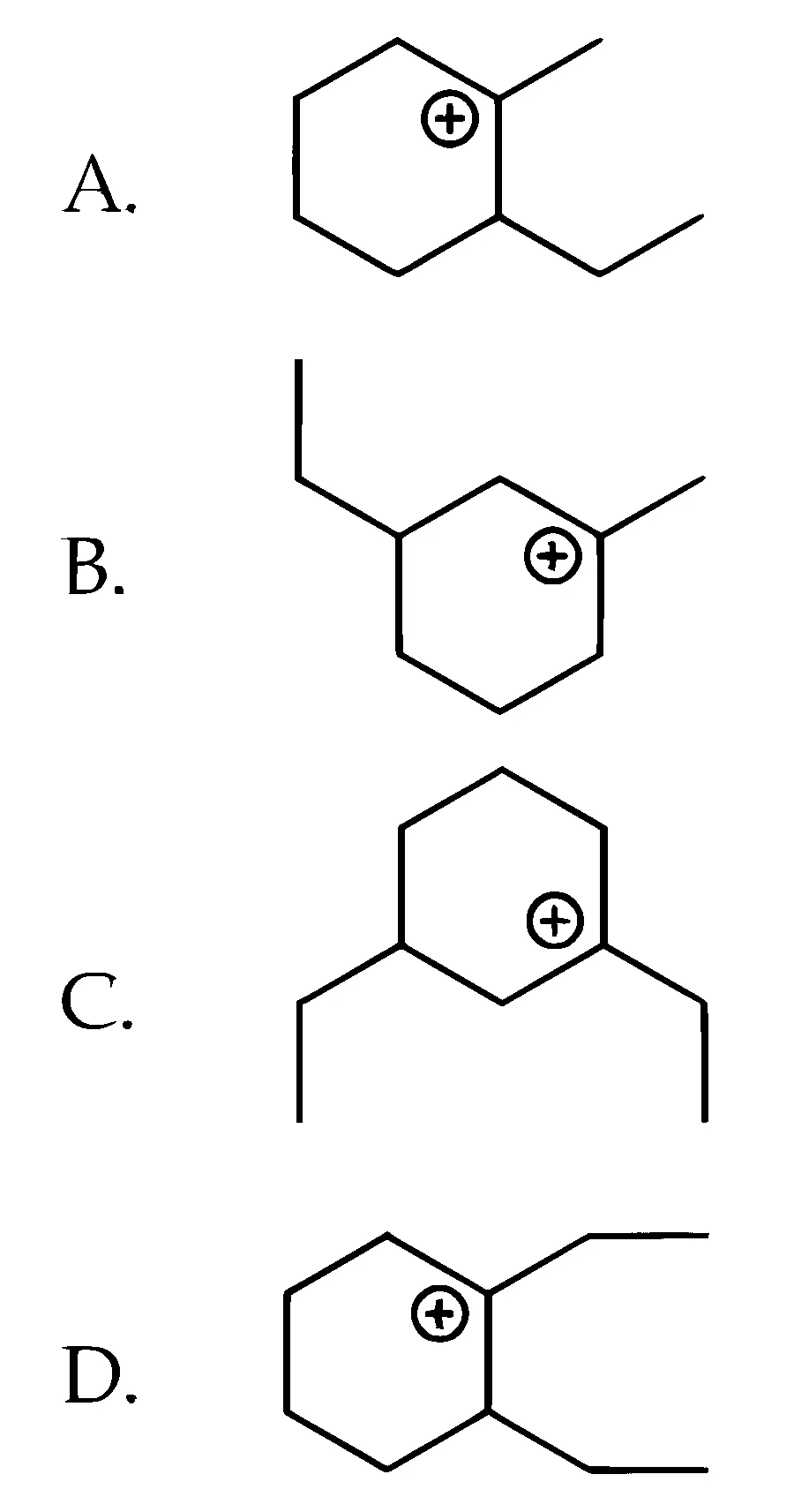
Choose the correct answer from the options given below :
Match List - I with List - II according to shape.
| List – I | List – II |
|---|---|
| A. XeO3 B. XeF2 C. XeO2F2 D. XeOF4 | I. BrF5 II. NH3 III. [I3]− IV. SF4 |
Choose the correct answer from the options given below :
Observe the following equilibrium in a 1 L flask.
A(g) ⇌ B(g)
At T(K), the equilibrium concentrations of A and B are 0.5 M and 0.375 M respectively. 0.1 moles of A is added into the flask and heated to T(K) to establish the equilibrium again. The new equilibrium concentrations (in M) of A and B are respectively
A → B (first reaction)
C → D (second reaction)
Consider the above two first-order reactions. The rate constant for first reaction at 500 K is double of the same at 300 K. At 500 K, 50% of the reaction becomes complete in 2 hour. The activation energy of the second reaction is half of that of first reaction. If the rate constant at 500 K of the second reaction becomes double of the rate constant of first reaction at the same temperature; then rate constant for the second reaction at 300 K is _______ × 10-1 hour-1 (nearest integer).
A student performed analysis of aliphatic organic compound ‘X’ which on analysis gave C = 61.01%, H = 15.25%, N = 23.74%.
This compound, on treatment with HNO2/H2O produced another compound ‘Y’ which did not contain any nitrogen atom. However, the compound ‘Y’ upon controlled oxidation produced another compound ‘Z’ that responded to iodoform test.
The structure of ‘X’ is :
Total number of alkali insoluble solid sulphonamides obtained by reaction of given amines with Hinsberg's reagent is ________.
Aniline, N-Methylaniline, Methanamine, N,N-Dimethylmethanamine, N-Methyl methanamine, Phenylmethanamine, N-propylaniline, N-phenylaniline, N,N-Dimethylaniline, Allyl amine, Isopropyl amine
The correct increasing order of spin-only magnetic moment values of the complex ions
[MnBr4]2− (A), [Cu(H2O)6]2+ (B), [Ni(CN)4]2− (C) and [Ni(H2O)6]2+ (D) is :
The number of isoelectronic species among
Consider the following statements about manganate and permanganate ions. Identify the correct statements.
A. The geometry of both manganate and permanganate ions is tetrahedral.
B. The oxidation states of Mn in manganate and permanganate are +7 and +6, respectively.
C. Oxidation of Mn(II) salt by peroxodisulphate gives manganate ion as the final product.
D. Manganate ion is paramagnetic and permanganate ion is diamagnetic.
E. Acidified permanganate ion reduces oxalate, nitrite and iodide ions.
Choose the correct answer from the options given below :
A volume of x mL of 5 M NaHCO3 solution was mixed with 10 mL of 2 M H2CO3 solution to make an electrolytic buffer. If the same buffer was used in the following electrochemical cell to record a cell potential of 235.3 mV, then the value of x = ______ mL (nearest integer).
Sn(s) | Sn(OH)62− (0.5 M) | HSnO2− (0.05 M) | OH− | Bi2O3(s) | Bi(s)
Consider up to one place of decimal for intermediate calculations
For strong electrolyte
Molar conductivity values of the solutions of strong electrolyte AB at 18°C are given below :
| c [mol L-1] | 0.04 | 0.09 | 0.16 | 0.25 |
|---|---|---|---|---|
| 96.1 | 95.7 | 95.3 | 94.9 |
The value of constant A based on the above data [in S cm2 mol-1/(mol/L)1/2] unit is ________.
Consider the following reactions
The oxidation states of Cu in Z and Q, respectively are :
Given below are two statements :
Statement I : The increasing order of boiling point of hydrogen halides is HCl < HBr < HI < HF.
Statement II : The increasing order of melting point of hydrogen halides is HCl < HBr < HF < HI.
In the light of the above statements, choose the correct answer from the options given below :
Consider the elements N, P, O, S, Cl and F. The number of valence electrons present in the elements with most and least metallic character from the above list is respectively.
A student has been given 0.314 g of an organic compound and asked to estimate Sulphur. During the experiment, the student has obtained 0.4813 g of barium sulphate. The percentage of sulphur present in the compound is _________. (Given Molar mass in g mol−1 S: 32, BaSO4: 233)
Consider the following aqueous solutions.
I. 2.2 g Glucose in 125 mL of solution.
II. 1.9 g Calcium chloride in 250 mL of solution.
III. 9.0 g Urea in 500 mL of solution.
IV. 20.5 g Aluminium sulphate in 750 mL of solution.
The correct increasing order of boiling point of these solutions will be :
[Given : Molar mass in g mol−1 : H = 1, C = 12, N = 14, O = 16, Cl = 35.5, Ca = 40, Al = 27 and S = 32]
For the given reaction;
CaCO3 + 2HCl → CaCl2 + H2O + CO2
If 90 g CaCO3 is added to 300 mL of HCl which contains 38.55% HCl by mass and has density 1.13 g mL−1, then which of the following option is correct?
Given molar mass of H, Cl, Ca and O are 1, 35.5, 40 and 16 g mol−1 respectively.
The wavelength of photon 'A' is 400 nm. The frequency of photon 'B' is
Two positively charged particles
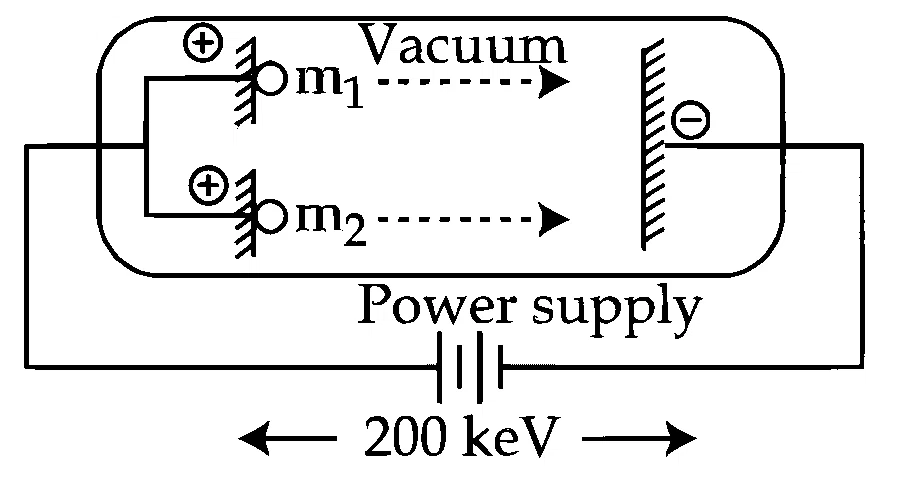
[Given mass of
The deBroglie wavelength of
The plot of