51JEE Main 2024 (Online) 5th April Evening Shift
INTEGER+4 / -12024Chemistry
The fusion of chromite ore with sodium carbonate in the presence of air leads to the formation of products
[Given atomic number :

JEE Main · 5 Apr 2024 · Answers and step-by-step solutions
Showing 25 of 90 questions · Page 3 of 4
The fusion of chromite ore with sodium carbonate in the presence of air leads to the formation of products
[Given atomic number :
The quantity of silver deposited when one coulomb charge is passed through
For the electro chemical cell
If
Which of the following is correct?
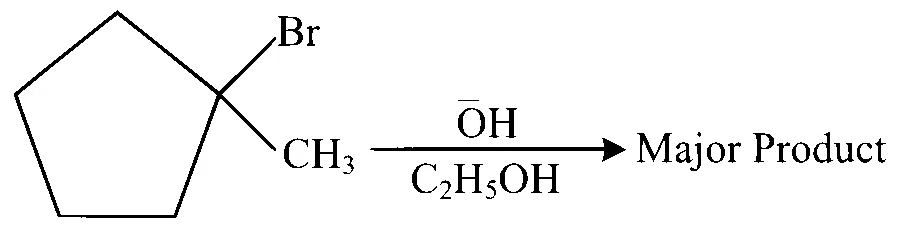
Identify the major product in the following reaction.
The correct statements from the following are :
(A) The decreasing order of atomic radii of group 13 elements is
(B) Down the group 13 electronegativity decreases from top to bottom.
(C)
(D) All elements of group 13 exhibits highly stable +1 oxidation state.
(E) Hybridisation of
Choose the correct answer from the options given below :
Given below are two statements :
Statement I : The metallic radius of
Statement II : Ions are always smaller in size than the corresponding elements.
In the light of the above statements, choose the correct answer from the options given below :
Considering acetic acid dissociates in water, its dissociation constant is
Acetic acid dissociates as
The number of moles of methane required to produce
In an atom, total number of electrons having quantum numbers
Combustion of 1 mole of benzene is expressed at
The standard enthalpy of combustion of
Given :
1. standard Enthalpy of formation of
2. Standard Enthalpy of formation of
3. Standard and Enthalpy of formation of
Let
Let the point
Let the maximum and minimum values of
The area enclosed between the curves
If the constant term in the expansion of
Let the circle
Let ABCD and AEFG be squares of side 4 and 2 units, respectively. The point E is on the line segment AB and the point F is on the diagonal AC. Then the radius r of the circle passing through the point F and touching the line segments BC and CD satisfies :
Let
Let
If
The differential equation of the family of circles passing through the origin and having centre at the line
Let
Then the area enclosed by the curve
If
Let
Then the function
Let ,