PracBee
Back

AIEEE 2010 Chemistry Questions

JEE Main · 25 Apr 2010 · Answers and step-by-step solutions

Paper PDF and print

PDF and print include all subjects in this paper.

Showing 25 of 30 Chemistry questions · Page 1 of 2

1AIEEE 2010
MCQ+4 / -12010Chemistry
From amongst the following alcohols the one that would react fastest with conc. HCl and anhydrous
ZnCl2, is
2AIEEE 2010
MCQ+4 / -12010Chemistry
One mole of a symmetrical alkene on ozonolysis gives two moles of an aldehyde having a molecular
mass of 44 u. The alkene is
3AIEEE 2010
MCQ+4 / -12010Chemistry
The correct order of increasing basicity of the given conjugate bases (R = CH3) is
4AIEEE 2010
MCQ+4 / -12010Chemistry
Out of the following, the alkene that exhibits optical isomerism is
5AIEEE 2010
MCQ+4 / -12010Chemistry
Biuret test is not given by
6AIEEE 2010
MCQ+4 / -12010Chemistry
In aqueous solution the ionization constants for carbonic acid are

K1 = 4.2 x 10⁻⁷ and K2 = 4.8 x 10⁻¹¹

Select the correct statement for a saturated 0.034 M solution of the carbonic acid.
7AIEEE 2010
MCQ+4 / -12010Chemistry
The time for half life period of a certain reaction A → products is 1 hour. When the initial
concentration of the reactant ‘A’, is 2.0 mol L–1, how much time does it take for its concentration to
come from 0.50 to 0.25 mol L–1 if it is a zero order reaction ?
8AIEEE 2010
MCQ+4 / -12010Chemistry

Consider the reaction :


Cl2(aq) + H2S(aq) → S(s) + 2H+ (aq) + 2Cl– (aq)


The rate equation for this reaction is rate = k [Cl2] [H2S]


Which of these mechanisms is/are consistent with this rate equation?


(A) Cl2 + H2S → H+ + Cl– + Cl+ + HS– (slow)


Cl+ + HS– → H+ + Cl– + S (fast)


(B) H2S ⇔ H+ + HS– (fast equilibrium)


Cl2 + HS– → 2Cl– + H+ + S (slow)

9AIEEE 2010
MCQ+4 / -12010Chemistry
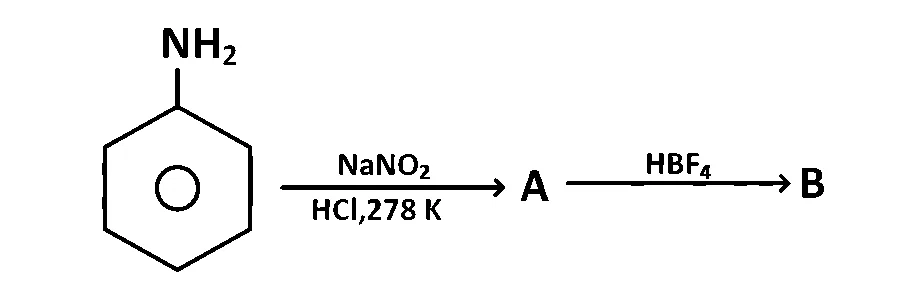
In the chemical reactions,


AIEEE 2010 Chemistry - Compounds Containing Nitrogen Question 237 English


the compounds ′A′ and ′B′ respectively are
10AIEEE 2010
MCQ+4 / -12010Chemistry
A solution containing 2.675g of CoCl3. 6NH3 (molar mass = 267.5 g mol–1) is passed through a cation exchanger. The chloride ions obtained in solution were treated with excess of AgNO3 to give
4.78 g of AgCl (molar mass = 143.5 g mol–1). The formula of the complex is : (At. Mass of Ag = 108 u)
11AIEEE 2010
MCQ+4 / -12010Chemistry
Which one of the following has an optical isomer ?

(en = ethylenediamine)
12AIEEE 2010
MCQ+4 / -12010Chemistry
The correct order of EM2+/Mo values with negative sign for the four successive elements Cr, Mn, Fe
and Co is :
13AIEEE 2010
MCQ+4 / -12010Chemistry
The Gibbs energy for the decomposition of Al2O3 at 500oC is as follows :


23Al2O3 → 43Al+O2, ΔrG = + 966 kJ mol–1


The potential difference needed for electrolytic reduction of Al2O3 at 500oC is at least :
14AIEEE 2010
MCQ+4 / -12010Chemistry
If 10–4 dm3 of water is introduced into a 1.0 dm3 flask to 300 K, how many moles of water are in the vapour phase when equilibrium is established ?

(Given : Vapour pressure of H2O at 300 K is 3170 Pa ; R = 8.314 J K–1 mol–1)
15AIEEE 2010
MCQ+4 / -12010Chemistry
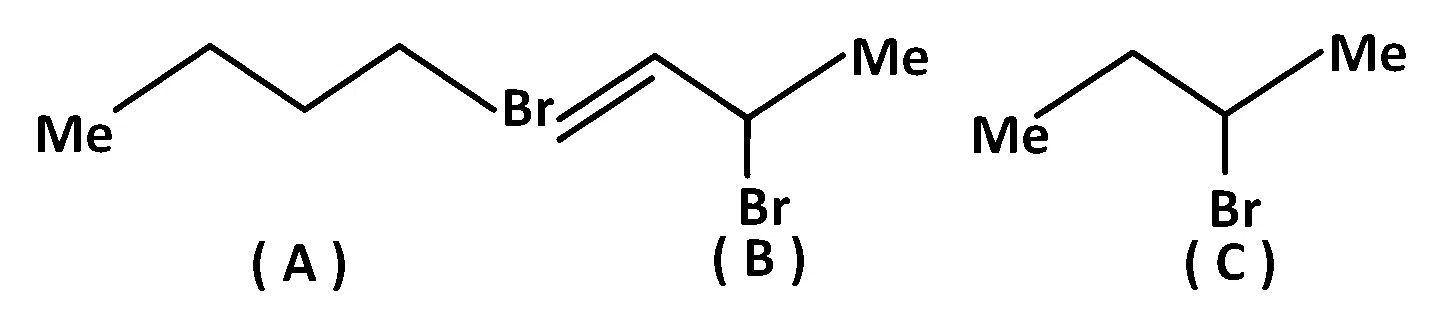
Consider the following bromides :


AIEEE 2010 Chemistry - Haloalkanes and Haloarenes Question 167 English


The correct order of SN1 reactive is
16AIEEE 2010
MCQ+4 / -12010Chemistry
The main product of the following reaction is


C6H5CH2CH(OH)CH(CH3)2⟶conc.H2SO4?
17AIEEE 2010
MCQ+4 / -12010Chemistry
Three reactions involving H2PO4− are given below :


(i) H3PO4 + H2O → H3O+ + H2PO4−


(ii) H2PO4− + H2O → HPO42− + H3O+


(iii) H2PO4− + OH- →H3PO4 + O2-


In which of the above does H2PO4− act as an acid?
18AIEEE 2010
MCQ+4 / -12010Chemistry
Solubility product of silver bromide is 5.0 × 10⁻¹³. The quantity of potassium bromide (molar mass taken as 120g of mol–1) to be added to 1 litre of 0.05 M solution of silver nitrate to start the
precipitation of AgBr is :
19AIEEE 2010
MCQ+4 / -12010Chemistry
At 25°C, the solubility product of Mg(OH)2 is 1.0 × 10⁻¹¹. At which pH, will Mg2+ ions start precipitating in the form of Mg(OH)2 from a solution of 0.001 M Mg2+ ions?
20AIEEE 2010
MCQ+4 / -12010Chemistry
The correct sequence which shows decreasing order of the ionic radii of the elements is
21AIEEE 2010
MCQ+4 / -12010Chemistry
The polymer containing strong intermolecular forces e.g. hydrogen bonding, is
22AIEEE 2010
MCQ+4 / -12010Chemistry
29.5 mg of an organic compound containing nitrogen was digested according to Kjeldahl’s method
and the evolved ammonia was absorbed in 20 mL of 0.1 M HCl solution. The excess of the acid
required 15 mL of 0.1 M NaOH solution for complete neutralization. The percentage of nitrogen in
the compound is
23AIEEE 2010
MCQ+4 / -12010Chemistry
Percentages of free space in cubic close packed structure and in body centred packed structure are
respectively :
24AIEEE 2010
MCQ+4 / -12010Chemistry
The edge length of a face centered cubic cell of an ionic substance is 508 pm. If the radius of the
cation is 110 pm, the radius of the anion is :
25AIEEE 2010
MCQ+4 / -12010Chemistry
If sodium sulphate is considered to be completely dissociated into cations and anions in aqueous
solution, the change in freezing point of water (∆Tf), when 0.01 mol of sodium sulphate is dissolved
in 1 kg of water, is (Kf = 1.86 K kg mol–1)