
Jee Advanced
Basics Of Organic Chemistry
JEE Advanced 2021 Paper 2 Online
MCQ+3 / -12021
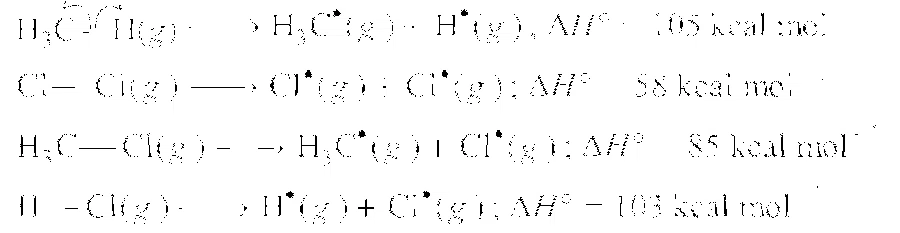
The amount of energy required to break a bond is same as the amount of energy released when the same bond is formed. In gaseous state, the energy required for homolytic cleavage of a bond is called Bond Dissociation Energy (BDE) or Bond Strength. BDE is affected by s-character of the bond and the stability of the radicals formed. Shorter bonds are typically stronger bonds. BDEs for some bonds are given below :
Correct match of the C-H bonds (shown in bold) in Column J with their BDE in Column K is
.tg {border-collapse:collapse;border-spacing:0;}
.tg td{border-color:black;border-style:solid;border-width:1px;font-family:Arial, sans-serif;font-size:14px;
overflow:hidden;padding:10px 5px;word-break:normal;}
.tg th{border-color:black;border-style:solid;border-width:1px;font-family:Arial, sans-serif;font-size:14px;
font-weight:normal;overflow:hidden;padding:10px 5px;word-break:normal;}
.tg .tg-c3ow{border-color:inherit;text-align:center;vertical-align:top}
.tg .tg-7btt{border-color:inherit;font-weight:bold;text-align:center;vertical-align:top}
.tg .tg-0pky{border-color:inherit;text-align:left;vertical-align:top}
.tg .tg-0lax{text-align:left;vertical-align:top}
.tg {border-collapse:collapse;border-spacing:0;}
.tg td{border-color:black;border-style:solid;border-width:1px;font-family:Arial, sans-serif;font-size:14px;
overflow:hidden;padding:10px 5px;word-break:normal;}
.tg th{border-color:black;border-style:solid;border-width:1px;font-family:Arial, sans-serif;font-size:14px;
font-weight:normal;overflow:hidden;padding:10px 5px;word-break:normal;}
.tg .tg-c3ow{border-color:inherit;text-align:center;vertical-align:top}
.tg .tg-7btt{border-color:inherit;font-weight:bold;text-align:center;vertical-align:top}
.tg .tg-0pky{border-color:inherit;text-align:left;vertical-align:top}
.tg .tg-0lax{text-align:left;vertical-align:top}
| Column J Molecule | Column K BDE (kcal \(mo{l^{ - 1}}\)) |
|---|---|
| (P) H-CH(\(C{H_3}\))\(_2\) | (i) 132 |
| (Q) H-CH\(_2\)Ph | (ii) 110 |
| (R) H-CH=CH\(_2\) | (iii) 95 |
| (S) H-C \(\equiv\) CH | (iv) 88 |