
Jee Advanced
Simple Harmonic Motion
IIT-JEE 2010 Paper 1 Offline
When a particle of mass m moves on the x-axis in a potential of the form V(x) = kx2, it performs simple harmonic motion. The corresponding time period is proportional to \(\sqrt {{m \over k}}\), as can be seen easily using dimensional analysis. However, the motion of a particle can be periodic even when its potential energy increases on both sides of x = 0 in a way different from kx2 and its total energy is such that the particle does not escape to infinity. Consider a particle of mass m moving on the x-axis. Its potential energy is V(x) = \(\alpha\)x4 (\(\alpha\) > 0) for | x | near the origin and becomes a constant equal to V0 for (see figure).
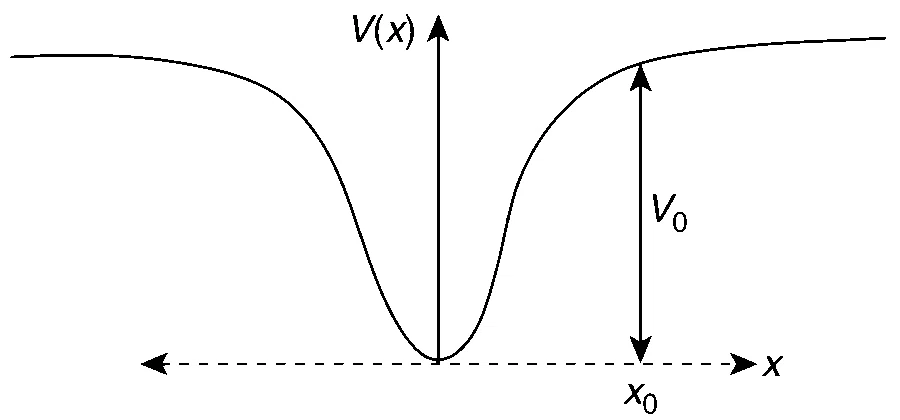
If the total energy of the particle is E, it will perform periodic motion only if