PracBee
Back

JEE Advanced 2013 Paper 2 Offline Question Paper

JEE Advanced · 2 Jun 2013 · Answers and step-by-step solutions

Paper PDF and print

Showing 25 of 60 questions · Page 2 of 3

26JEE Advanced 2013 Paper 2 Offline
MCQ+3 / -12013Chemistry

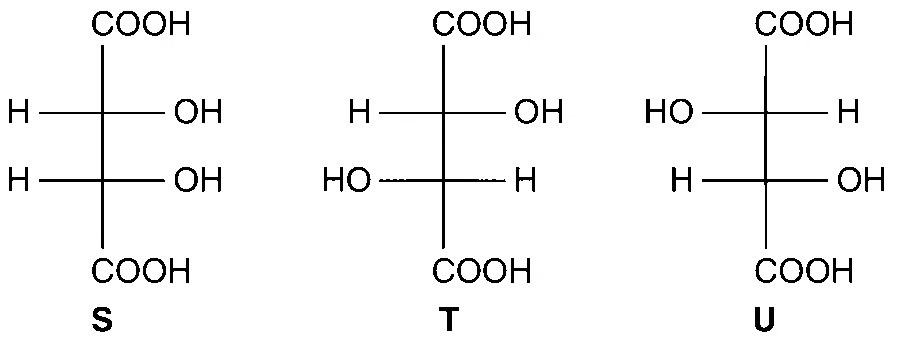
P and Q are isomers of dicarboxylic acid C4H4O4. Both decolorise Br2/H2O. On heating, P forms the cyclic anhydride. Upon treatment with dilute alkaline KMnO4, P as well as Q could produce one or more than one from S, T and U.

JEE Advanced 2013 Paper 2 Offline Chemistry - Aldehydes, Ketones and Carboxylic Acids Question 49 English Comprehension

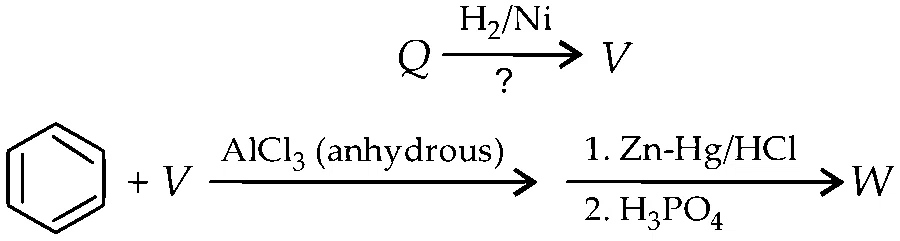
In the following reaction sequences V and W are, respectively,

JEE Advanced 2013 Paper 2 Offline Chemistry - Aldehydes, Ketones and Carboxylic Acids Question 49 English

27JEE Advanced 2013 Paper 2 Offline
MCQM+3 / -0.752013Chemistry
The thermal dissociation equilibrium of CaCO3(s) is studied under different conditions


CaCO3(s) ⇋ CaO(s) + CO2(g).

For this equilibrium, the correct statement(s) is (are)
28JEE Advanced 2013 Paper 2 Offline
MCQM+4 / -12013Chemistry
In the nuclear transmutation


9Be4 + X → 8Be4 + Y


(X, Y) is (are) :
29JEE Advanced 2013 Paper 2 Offline
MCQ+6 / -1.52013Chemistry
An aqueous solution of X is added slowly to an aqueous solution of Y as shown in List – I. The variation in
conductivity of these reactions in List – II. Match List – I with List – II and select the correct answer using
the code given below the lists:


List - I

P. (C2H5)3NX + CH3COOHY

Q. KI(0.1M)X + AgNO3(0.01M)Y

R. CH3COOHX + KOHY

S. NaOHX + HIY


List - II

1. Conductivity decreases then increases

2. Conductivity decreases then does not change much

3. Conductivity increases then does not change much

4. Conductivity does not change much then increases
30JEE Advanced 2013 Paper 2 Offline
MCQ+6 / -1.52013Chemistry
The standard reduction potential data at 25oC is given below:

Eo (Fe3+ , Fe2+) = +0.77V;

Eo (Fe2+ , Fe) = -0.44V;

Eo (Cu2+ , Cu) = +0.34V;

Eo (Cu+ , Cu) = +0.52V;

Eo [O2(g) + 4H+ + 4e- → 2H2O] = +1.23V;

Eo [O2(g) + 2H2O + 4e- → 4OH-] = +0.40 V

Eo (Cr3+ , Cr) = -0.74V;

Eo (Cr2+ , Cr) = -0.91V;


Match Eo of the redox pair in List – I with the values given in List – II and select the correct answer using
the code given below the lists:


List - I

P. Eo (Fe3+ , Fe)

Q. Eo (4H2O ⇋ 4H+ + 4OH-)

R. Eo (Cu2+ + Cu → 2Cu+)

S. Eo (Cr3+, Cr2+)


List - II

1. -0.18 V

2. -0.4 V

3. -0.04 V

4. -0.83 V
31JEE Advanced 2013 Paper 2 Offline
MCQM+3 / -0.752013Chemistry
The Ksp of Ag2CrO4 is 1.1 × 10⁻¹² at 298 K. The solubility (in mol/L) of Ag2CrO4 in a 0.1 M AgNO3 solution is
32JEE Advanced 2013 Paper 2 Offline
MCQM+3 / -0.752013Chemistry
The carbon–based reduction method is NOT used for the extraction of
33JEE Advanced 2013 Paper 2 Offline
MCQM+4 / -22013Chemistry

The correct statement(s) about O3 is(are)

34JEE Advanced 2013 Paper 2 Offline
MCQ+3 / -12013Chemistry

The reaction of Cl2 gas with cold-dilute and hot-concentrated NaOH in water give sodium salts of two (different) oxoacids of chlorine, P and Q, respectively. The Cl2 gas reacts with SO2 gas, in presence of charcoal, to give a product R. R reacts with white phosphorus to give a compound S. On hydrolysis, S gives an oxoacid of phosphorus, T.

P and Q, respectively, are the sodium salts of
35JEE Advanced 2013 Paper 2 Offline
MCQ+3 / -12013Chemistry

The reaction of Cl2 gas with cold-dilute and hot-concentrated NaOH in water give sodium salts of two (different) oxoacids of chlorine, P and Q, respectively. The Cl2 gas reacts with SO2 gas, in presence of charcoal, to give a product R. R reacts with white phosphorus to give a compound S. On hydrolysis, S gives an oxoacid of phosphorus, T.

R, S and T respectively, are

36JEE Advanced 2013 Paper 2 Offline
MCQ+3 / -12013Chemistry

The unbalanced chemical reactions given in List I show missing reagent or condition (?) which are provided in List II. Match List I with List II and select the correct answer using the code given below the lists :


List IList II
P.PbO2+H2SO4⟶?PbSO4+O2+Otherproducts1.NO
Q.Na2S2O3+H2O⟶?NaHSO4+Otherproducts2.I2
R.N2H4⟶?N2+Otherproducts3.Warm
S.XeF2⟶?Xe+Otherproducts4.Cl2

37JEE Advanced 2013 Paper 2 Offline
MCQ+3 / -12013Chemistry

An aqueous solution of a mixture of two inorganic salts, when treated with dilute HCl, gave a precipitate (P) and a filtrate (Q). The precipitate (P) was found to dissolve in hot water. The filtrate (Q) remained unchanged, when treated with H2S in a dilute mineral acid medium. However, it gave a precipitate (R) with H2S in an ammoniacal medium. The precipitate R gave a coloured solution (S), when treated with H2O2 in an aqueous NaOH medium.

The precipitate P contains

38JEE Advanced 2013 Paper 2 Offline
MCQ+3 / -12013Chemistry

An aqueous solution of a mixture of two inorganic salts, when treated with dilute HCl, gave a precipitate (P) and a filtrate (Q). The precipitate (P) was found to dissolve in hot water. The filtrate (Q) remained unchanged, when treated with H2S in a dilute mineral acid medium. However, it gave a precipitate (R) with H2S in an ammoniacal medium. The precipitate R gave a coloured solution (S), when treated with H2O2 in an aqueous NaOH medium.

The coloured solution S contains

39JEE Advanced 2013 Paper 2 Offline
MCQ+3 / -12013Chemistry

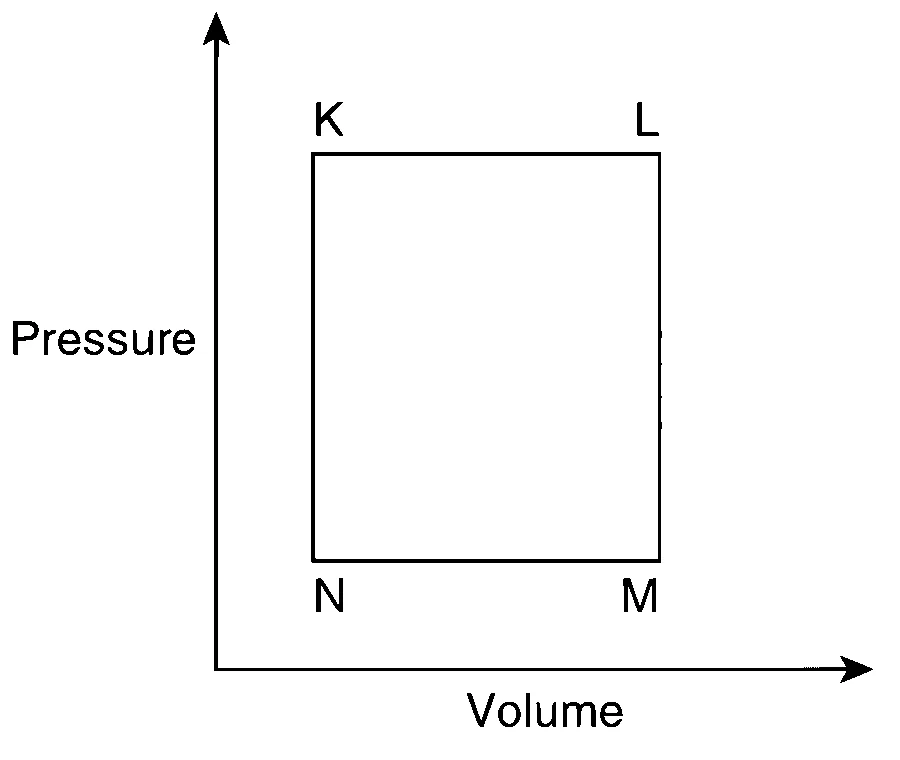
A fixed mass m of a gas is subjected to transformation of states from K to L to M to N and back to K as shown in the figure.


JEE Advanced 2013 Paper 2 Offline Chemistry - Thermodynamics Question 24 English Comprehension

The succeeding operations that enable this transformation of states are

40JEE Advanced 2013 Paper 2 Offline
MCQ+3 / -12013Chemistry

A fixed mass m of a gas is subjected to transformation of states from K to L to M to N and back to K as shown in the figure.


JEE Advanced 2013 Paper 2 Offline Chemistry - Thermodynamics Question 23 English Comprehension

The pair of isochoric processes among the transformation of states is

41JEE Advanced 2013 Paper 2 Offline
MCQM+4 / -12013Mathematics
Two lines L1:x=5,y3−α=z−2 and L2:x=α,y−1=z2−α are coplanar. Then α can take value(s)
42JEE Advanced 2013 Paper 2 Offline
MCQ+4 / -12013Mathematics
Consider the lines

L1:x−12=y−1=z+31,L2:x−41=y+31=z+32

and the planes P1:7x+y+2z=3,P2=3x+5y−6z=4. Let ax+by+cz=d be the equation of the plane passing through the point of intersection of lines L1 and L2, and perpendicular to planes P1 and P2.

Match List I with List II and select the correct answer using the code given below the lists:

List I

(P.) a=

(Q.) b=

(R.) c=

(S.) d=


List II

(1.) 13

(2.) −3

(3.) 1

(4.) −2


43JEE Advanced 2013 Paper 2 Offline
MCQM+4 / -22013Mathematics

The function f(x)=2|x|+|x+2|−||x+2|−2|x|| has a local minimum or a local maximum at x =

44JEE Advanced 2013 Paper 2 Offline
MCQ+4 / -12013Mathematics
Let f:[0,1]→R (the set of all real numbers) be a function. Suppose the function f is twice differentiable,
f(0)=f(1)=0 and satisfies f″(x)−2f′(x)+f(x)≥.ex,x∈[0,1].

Which of the following is true for 0<x<1?

45JEE Advanced 2013 Paper 2 Offline
MCQ+4 / -12013Mathematics
Let f:[0,1]→R (the set of all real numbers) be a function. Suppose the function f is twice differentiable,
f(0)=f(1)=0 and satisfies f″(x)−2f′(x)+f(x)≥.ex,x∈[0,1].

If the function e−xf(x) assumes its minimum in the interval [0,1] at x=14, which of the following is true?

46JEE Advanced 2013 Paper 2 Offline
MCQM+4 / -12013Mathematics
Circle (s) touching x-axis at a distance 3 from the origin and having an intercept of length 27 on y-axis is (are)
47JEE Advanced 2013 Paper 2 Offline
MCQM+4 / -12013Mathematics

Let ω=3+i2 and P={ωn:n=1,2,3,…}. Further


H1={z∈C:Rez<12} and


H2={z∈C:Rez<−12}, where C is the


set of all complex numbers. If z1∈P∩H1,z2∈ P∩H2 and O


represents the origin, then ∠z1Oz2=

48JEE Advanced 2013 Paper 2 Offline
MCQ+4 / -12013Mathematics
Let S=S1∩S2∩S3, where S1={z∈C:|z|<4},S2={z∈C:Im[z−1+3i1−3i]>0} and S3={z∈C:Rez>0}.

Area of S =

49JEE Advanced 2013 Paper 2 Offline
MCQ+4 / -12013Mathematics
Let S=S1∩S2∩S3, where S1={z∈C:|z|<4},S2={z∈C:Im[z−1+3i1−3i]>0} and S3={z∈C:Rez>0}.

minz∈S⁡|1−3i−z|=

50JEE Advanced 2013 Paper 2 Offline
MCQ+4 / -12013Mathematics
Match List I with List II and select the correct answer using the code given below the lists:

List I

P. (1y2(cos⁡(tan−1y)+ysin⁡(tan−1y)cot⁡(sin−1y)+tan⁡(sin−1y))2+y4)1/2 takes value

Q. If cos⁡x+cos⁡y+cos⁡z=0=sin⁡x+sin⁡y+sin⁡z then

possible value of cos⁡x−y2 is


R. If cos⁡(π4−x)cos⁡2x+sin⁡xsin⁡2sec⁡x=cos⁡xsin⁡2xsec⁡x+

cos⁡(π4+x)cos⁡2x then possible value of sec⁡x is


S. If cot⁡(sin−11−x2)=sin⁡(tan−1(x6)),x≠0,

Then possible value of x is


List II

1. 1253

2. 2


3. 12


1. 1


More 2013 JEE Advanced papers