26AP EAPCET 2021 - 19th August Morning Shift
MCQ+1 / -02021Chemistry
The molal elevation constant is the ratio of
elevation in boiling point to

AP EAPCET · 19 Aug 2021 · Answers and step-by-step solutions
PDF and print include all subjects in this paper.
Showing 15 of 40 Chemistry questions · Page 2 of 2
The molal elevation constant is the ratio of
elevation in boiling point to
A compound A is used in paints instead of
salts of lead. Compound A is obtained when a
white compound B is strongly heated.
Compound B is insoluble in water but
dissolves in NaOH solution forming a
solution of compound C. The compound A on
heating with coke gives a volatile metal D
and a gas E which burns with a blue flame.
Identify the possible species D and C can be
respectively?
Identify (P) and (Q) in the following reaction.
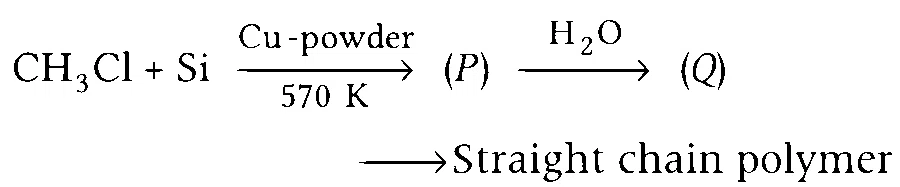
Match the following compounds with their corresponding physical properties.
| Column I | Column II | ||
|---|---|---|---|
| A. | 1. | Orange solid | |
| B. | 2. | Yellow-green liquid | |
| C. | 3. | Black solid | |
| D. | 4. | Colourless gas |
Which of the following represents the correct
order of increasing electron gain enthalpy
with negative sign for the elements?
1. Nitrogen (N) 2. Phosphorus (P) 3. Chlorine (Cl) 4. Fluorine (F)
In Lassaigne’s test for halogens, it is
necessary to remove X and Y from the
sodium fusion extract, if nitrogen and
sulphur are present. This is done by boiling
the extract with Z. Identify X, Y and Z.
Which among the following species acts as a
self-indicator?
Which metal oxide among the following
gives H
Assertion (A) K, Rb and Cs form
superoxides.
Reason (R) The stability of superoxides
increases from K to Cs due to decrease in
lattice energy.
When borax is dissolved in water, it gives an alkaline solution. The alkaline solution consists the following products
When 20 g of CaCO
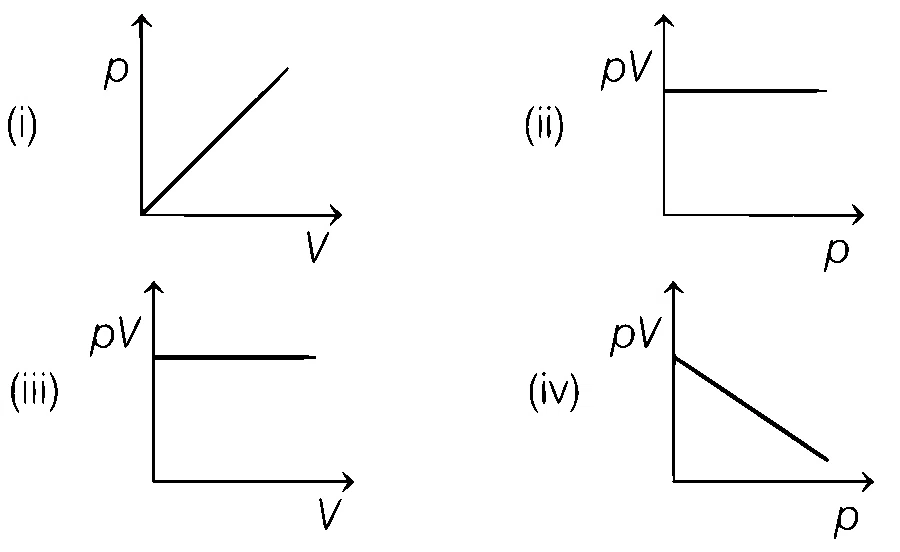
Which of the following graphs correctly
represents Boyle’s Law?
The density of an ideal gas can be given by
........, where p, V, M, T and R respectively
denote pressure, volume, molar-mass,
temperature and universal gas constant.
A plot of
If a chemical reaction is known to be
non-spontaneous at 298 K but spontaneous
at 350 K, then which among the following
conditions is true for the reaction?