
Match List-I with List-II :
| List-I (Compounds) | List-II (Molecular formula) | ||
|---|---|---|---|
| (a) | Borax | (i) | NaBO |
| (b) | Kernite | (ii) | Na |
| (c) | Orthoboric acid | (iii) | H |
| (d) | Borax bead | (iv) | Na |
Choose the correct answer from the options given below :
NEET · 4 Sept 2022 · Answers and step-by-step solutions
PDF and print include all subjects in this paper.
Showing 25 of 50 Chemistry questions · Page 2 of 2
Match List-I with List-II :
| List-I (Compounds) | List-II (Molecular formula) | ||
|---|---|---|---|
| (a) | Borax | (i) | NaBO |
| (b) | Kernite | (ii) | Na |
| (c) | Orthoboric acid | (iii) | H |
| (d) | Borax bead | (iv) | Na |
Choose the correct answer from the options given below :
Which of the following reactions is a part of the large scale industrial preparation of nitric acid?
Na2B4O7
in the above reaction the product "X" is :
The correct order of first ionization enthalpy for the given four elements is :
Decrease in size from left to right in actinoid series is greater and gradual than that in lanthanoid series due to
Fluorine is a stronger oxidising agent than chlorine because :
(a) F-F bond has a low enthalpy of dissociation.
(b) Fluoride ion (F
(c) Electron gain enthalpy of fluorine is less negative than chlorine.
(d) Fluorine has a very small size.
Choose the most appropriate answer from the options given :
If first ionization enthalpies of elements X and Y are 419 kJ mol
Which among the following is a thermoplastic polymer?
Which of the following reactions is a decomposition redox reaction?
The element used for welding metals with high melting points is
CaCl2 and Ca(OCl)2 are components of
Which one of the following is not a calcination reaction?
Match List-I with List-II :
| List-I (Defects) | List-II (Shown by) | ||
|---|---|---|---|
| (a) | Frenkel defect | (i) | Non-ionic solids and density of the solid decreases |
| (b) | Schottky defect | (ii) | Non-ionic solids and density of the solid increases |
| (c) | Vacancy defect | (iii) | Ionic solids and density of the solid decreases |
| (d) | Interstitial defect | (iv) | Ionic solids and density of the solid remains constant |
Choose the correct answer from the options given below :
KH value for some gases at the same temperature 'T' are given :
| Gas | K |
|---|---|
| Ar | 40.3 |
| CO | 1.67 |
| HCHO | 1.83 |
| CH | 0.413 |
where KH is Henry's Law constant in water. The order of their solubility in water is :
The density of the solution is 2.15 g mL
What fraction of Fe exists as Fe(III) in Fe0.96O ?
(Consider Fe0.96O to be made up of Fe(II) and Fe(III) only)
Given below are two statements : one is labelled as Assertion (A) and the other is labelled as Reason (R).
Assertion (A) : Chlorine is an electron withdrawing group but it is ortho, para directing in electrophilic aromatic substitution.
Reason (R) : Inductive effect of chlorine destabilises the intermediate carbocation formed during the electrophilic substitution, however due to the more pronounced resonance effect, the halogen stabilises the carbocation at ortho and para positioins.
In the light of the above statements, choose the most appropriate answer from the options given below :
Predict the order of reactivity of the following four isomers towards SN2 reaction.
(I) CH3CH2CH2CH2Cl
(II) CH3CH2CH(Cl)CH3
(III) (CH3)2CHCH2Cl
(IV) (CH3)3CCl
What is the hybridization shown by C1 and C2 carbons, respectively in the given compound?
OHC
Which of the following is the most stable carbocation?
Match List-I with List-II :
| List-I (quantum number) | List-II (orbital) | ||
|---|---|---|---|
| (a) | n = 2, l = 1 | (i) | 2s |
| (b) | n = 3, l = 2 | (ii) | 3s |
| (c) | n = 3, l = 0 | (iii) | 2p |
| (d) | n = 2, l = 0 | (iv) | 3d |
Choose the correct answer from the options given below :
When electromagnetic radiation of wavelength 300 nm falls on the surface of a metal, electrons are emitted with the kinetic energy of 1.68
(h = 6.626
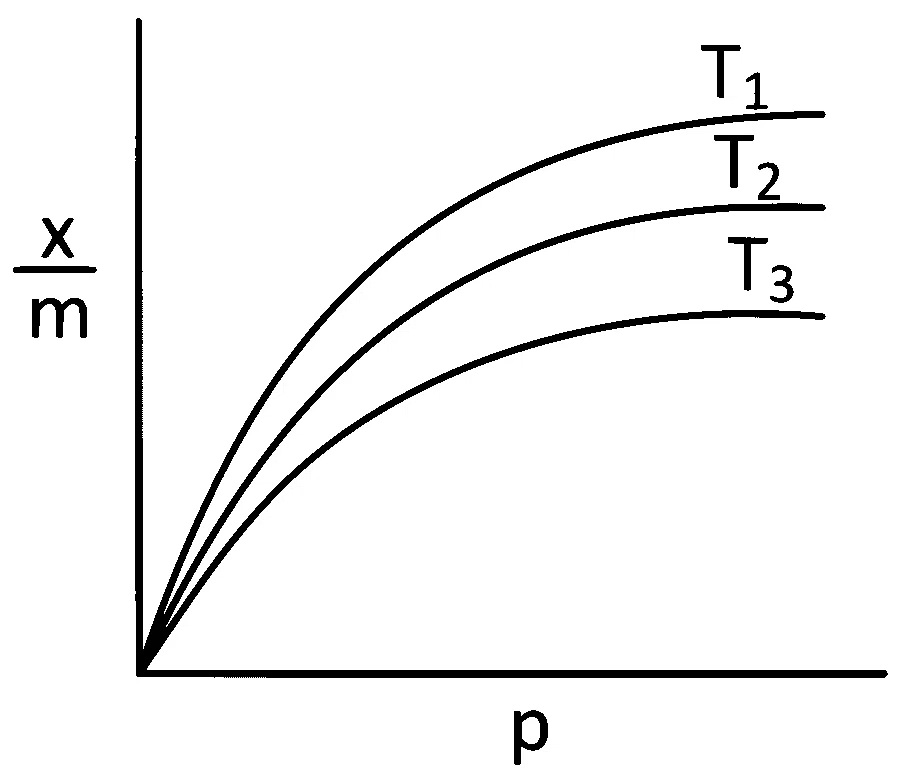
Shown below are adsorption isotherms for a gas 'X' at temperatures T1, T2 and T3 :

p and
One mole of an ideal gas at 300 K is expanded isothermally from 1 L to 10 L volume.
(Use R = 8.314 J k
A vessel contains 3.2 g of dioxygen gas at STP (273.15 K and 1 atm pressure). The gas is now transferred to another vessel at constant temperature, where pressure becomes one third of the original pressure. The volume of new vessel in L is : (Given : molar volume at STP is 22.4 L)