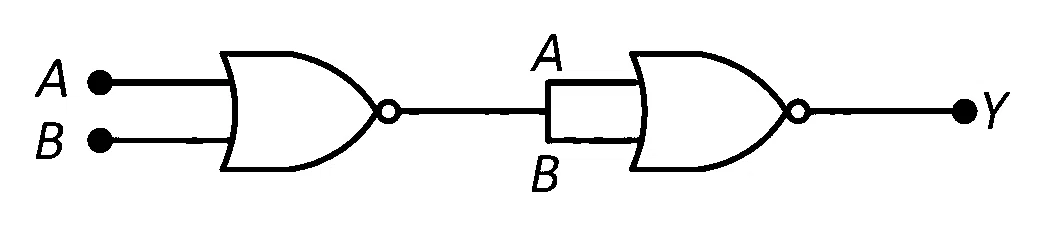
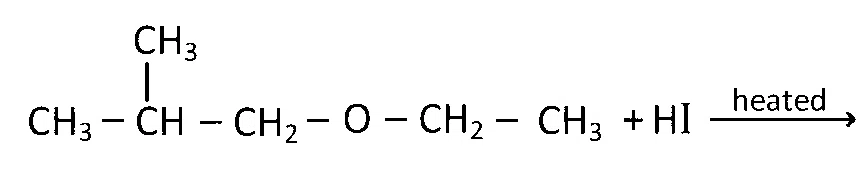
A particle starting from the origin (0, 0) moves in a straight line in the (x, y) planes. Its coordinates at a later time are . The path of the particle makes with the x-axes an angle of
The positions x of a particle with respect to time t along x-axis is given by x = 9t2 t3 where x is in metres and t in seconds. What will be the position of this particle when it achieves maximum speed along the + x direction ?
A particle moving along x-axis has acceleration f, at time t, given by f = f0 where f0 and T are constants.The particle at t = 0 has zero velocity. In the time interval between t = 0 and the instant when f = 0, the particle's velocity (vx) is
Under the influence of a uniform magnetic field, a charged particle moves with constant speed v in a circle of radius R. The time period of rotation of the particle
The resistance of an ammeter is 13 and its scale is graduated for a current upto 100 amps. After an additional shunt has been connected to this ammeter it becomes possible to measure currents upto 750 amperes by this meter. The value of shunt-resistance is
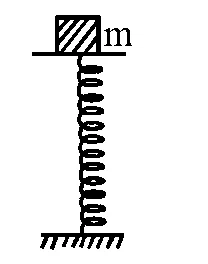
A mass of 2.0 kg is put on a flat pan attached to a vertical spring fixed on the ground as shown in the figure. The mass of the spring and the pan is negligible.
When pressed slightly and released the mass executes a simple harmonic motion. The spring constant is 200 N/m. What should be the minimum amplitude of the motion so that the mass gets detached from the pan (take g = 10 m/s2).
The particle executing simple harmonic motion has a kinetic energy K0cos2t. The maximum values of the potential energy and the total energy are respectively
A particle executes simple harmonic oscillation with an amplitude . The period of oscillation is T. The minimum time taken by the particle to travel half of the amplitude from the equilibrium position is
Assuming the sun to have a spherical outer surface of radius r, radiating like a black body at temperature toC, the power received by a unit surface, (normal to the incident rays) at a distance R from the centre of the sun is
A wheel has angular acceleration of 3.0 rad/sec2 and an initial angular speed of 2.00 rad/sec. In a time of 2 sec it has rotated through an angle (in radian) of
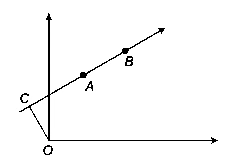
A particle of mass m moves in the XY plane with a velocity v along the straight line AB. If the angular momentum of the particle with respect to origin O is LA when it is at A and LB when it is at B, then
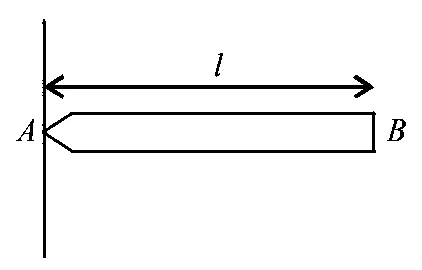
A uniform rod AB of length and mass m is free to rotate about point A. The rod is released from rest in the horizontal position. Given that the moment of inertia of the rod about A is ml2/3, the initial angular acceleration of the rod will be
A vertical spring with force constant k is fixed on a table. A ball of mass m at a height h above the free upper end of the spring falls vertically on the spring so that the spring is compressed by a distance d. The net work done in the process is