PracBee
Back

AIEEE 2006 Question Paper

JEE Main · 29 Apr 2006 · Answers and step-by-step solutions

Paper PDF and print

Showing 25 of 144 questions · Page 3 of 6

51AIEEE 2006
MCQ+4 / -12006Physics
A particle of mass 100g is thrown vertically upwards with a speed of 5 m/s. The work done by the force of gravity during the time the particle goes up is

52AIEEE 2006
MCQ+4 / -12006Physics
The potential energy of a 1 kg particle free to move along the x-axis is given by V(x)=(x44−x22)J.

The total mechanical energy of the particle is 2J. Then, the maximum speed (in m/s) is
53AIEEE 2006
MCQ+4 / -12006Physics
A ball of mass 0.2 kg is thrown vertically upwards by applying a force by hand. If the hand moves 0.2 m while applying the force and the ball goes upto 2 m height further, find the magnitude of the force. (consider g=10m/s2).
54AIEEE 2006
MCQ+4 / -12006Chemistry
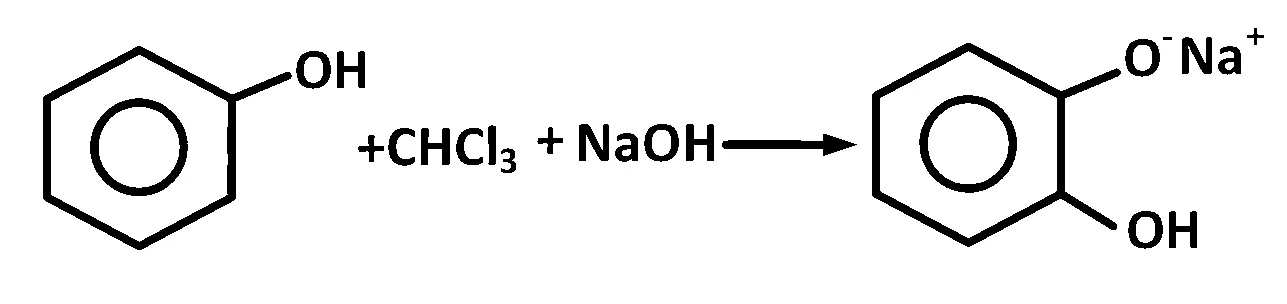
AIEEE 2006 Chemistry - Alcohols, Phenols and Ethers Question 163 English


The electrophile involved in the above reaction is
55AIEEE 2006
MCQ+4 / -12006Chemistry
Phenyl magnesium bromide reacts with methanol to give
56AIEEE 2006
MCQ+4 / -12006Chemistry
The structure of the compound that gives a tribromo derivative on treatment with bromine water is
57AIEEE 2006
MCQ+4 / -12006Chemistry
HBr reacts with CH2 = CH – OCH3 under anhydrous conditions at room temperature to give
58AIEEE 2006
MCQ+4 / -12006Chemistry
Among the following the one that gives positives iodoform test upon reaction with I2 and NaOH is
59AIEEE 2006
MCQ+4 / -12006Chemistry
The increasing order of the rate of HCN addition to compounds A – D is

(A) HCHO
(B) CH3COCH3

(C) PhCOCH3
(D) PhCOPh
60AIEEE 2006
MCQ+4 / -12006Chemistry
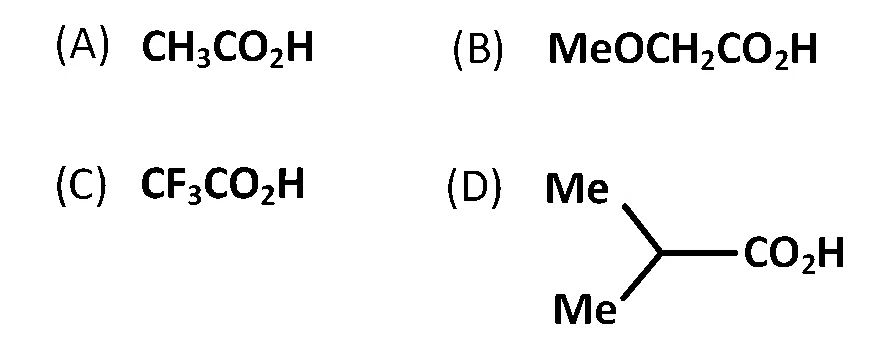
The correct order of increasing acid strength of the compounds


AIEEE 2006 Chemistry - Aldehydes, Ketones and Carboxylic Acids Question 258 English
61AIEEE 2006
MCQ+4 / -12006Chemistry
CH3Br + Nu- → CH3 - Nu + Br- The decreasing order of the rate of the above reaction with nucleophiles (Nu–) A to D is

[Nu– = (A) PhO–, (B) AcO–, (C) HO–, (D) CH3O–]
62AIEEE 2006
MCQ+4 / -12006Chemistry
The increasing order of stability of the following free radicals is
63AIEEE 2006
MCQ+4 / -12006Chemistry
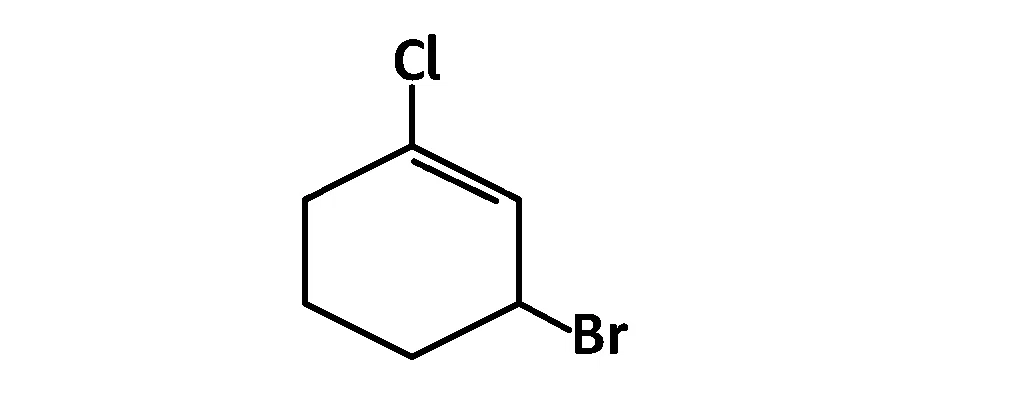
The IUPAC name of the compound shown below is :


AIEEE 2006 Chemistry - Basics of Organic Chemistry Question 257 English
64AIEEE 2006
MCQ+4 / -12006Chemistry
Increasing order of stability among the three main conformations (i.e. Eclipse, Anti, Gauche) of
2-fluoroethanol is
65AIEEE 2006
MCQ+4 / -12006Chemistry
The term anomers of glucose refers to
66AIEEE 2006
MCQ+4 / -12006Chemistry
The pyrimidine bases present in DNA are
67AIEEE 2006
MCQ+4 / -12006Chemistry
The decreasing values of bond angles from NH3 (106o) to SbH3 (91o
) down group-15 of the periodic table is due to
68AIEEE 2006
MCQ+4 / -12006Chemistry
Which of the following molecules/ions does not contain unpaired electrons?
69AIEEE 2006
MCQ+4 / -12006Chemistry
In which of the following molecules/ions are all the bonds not equal?
70AIEEE 2006
MCQ+4 / -12006Chemistry
Phosphorus pentachloride dissociates as follows, in a closed reaction vessel

PCl5 (g) ⇋ PCl3 (g) + Cl2 (g)

If total pressure at equilibrium of the reaction mixture is P and degree of dissociation of PCl5 is x, the
partial pressure of PCl3 will be
71AIEEE 2006
MCQ+4 / -12006Chemistry
The equilibrium constant for the reaction

SO3 (g) ⇋ SO2 (g) + 12 O2 (g)

is Kc = 4.9 × 10⁻². The value of Kc for the reaction

2SO2 (g) + O2 (g) ⇋ 2SO3 (g) will be :
72AIEEE 2006
MCQ+4 / -12006Chemistry
The following mechanism has been proposed for the reaction of NO with Br2 to form NOBr:

NO(g) + Br2 (g) ⇋ NOBr2 (g)

NOBr2 (g) + NO (g) → 2NOBr (g)

If the second step is the rate determining step, the order of the reaction with respect to NO(g) is
73AIEEE 2006
MCQ+4 / -12006Chemistry
Rate of a reaction can be expressed by Arrhenius equation as:

$k=Ae−E/RT$
In this equation, E represents
74AIEEE 2006
MCQ+4 / -12006Chemistry
A reaction was found to be second order with respect to the concentration of carbon monoxide. If the
concentration of carbon monoxide is doubled, with everything else kept the same, the rate of reaction
will
75AIEEE 2006
MCQ+4 / -12006Chemistry
In the transformation of 92238U to 92234U, if one emission is an α-particle, what should be the other
emission(s)?