
JEE Advanced
Aldehydes Ketones And Carboxylic Acids PYQJEE Advanced 2013 Paper 2 Offline
P and Q are isomers of dicarboxylic acid C4H4O4. Both decolorise Br2/H2O. On heating, P forms the cyclic anhydride. Upon treatment with dilute alkaline KMnO4, P as well as Q could produce one or more than one from S, T and U.
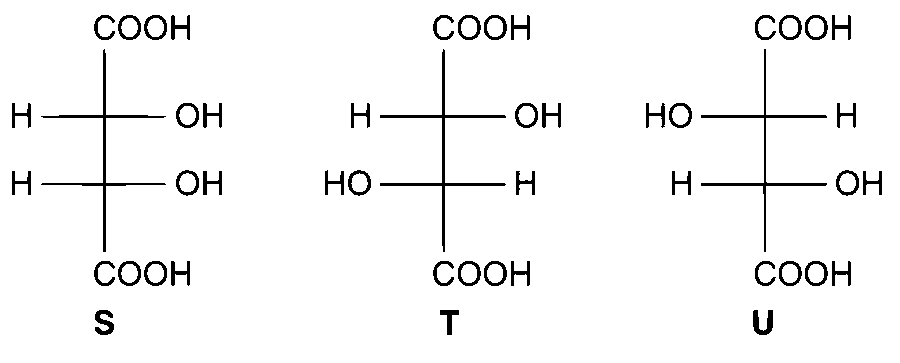
Compounds formed from P and Q are, respectively,
Solution
Correct option: B
Answer: B
Identify P and Q
Since only P forms a cyclic anhydride on heating, P is the cis-isomer of butenedioic acid, while Q is the trans-isomer.
Oxidation of P
Dilute alkaline
Optical nature of S
The product S has an internal plane of symmetry, so it is a meso form and is optically inactive.
Oxidation of Q
For trans-Q, the same hydroxylation gives the pair T and U, which are formed as an enantiomeric pair.
Conclusion
An enantiomeric pair formed in equal amounts is optically inactive. Thus P gives optically inactive S, and Q gives optically inactive pair