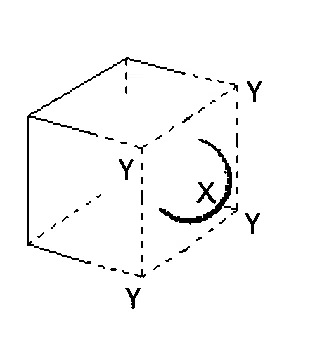
For the given close packed structure of a salt made of cation X and anion Y shown below (ions of only one face are shown for clarity), the packing fraction is approximately (packing fraction = )
The boiling point of water in a 0.1 molal silver nitrate solution (solution A) is xC. To this solution A, an equal volume of 0.1 molal aqueous barium chloride solution is added to make a new solution B. The difference in the boiling points of water in the two solutions A and B is y 102C.
(Assume : Densities of the solutions A and B are the same as that of water and the soluble salts dissociate completely.
Use : Molal elevation constant (Ebullioscopic Constant), Kb = 0.5 K kg mol1; Boiling point of pure water as 100C.)
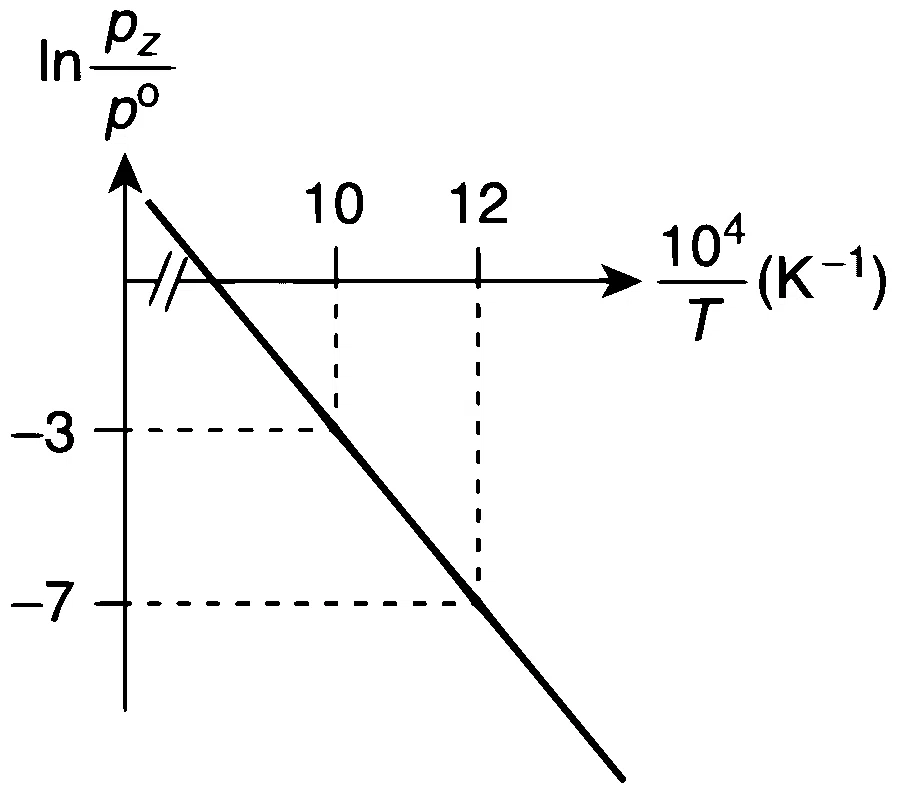
For the reaction, X(s) Y(s) + Z(g), the plot of versus is given below (in solid line), where pz is the pressure (in bar) of the gas Z at temperature T and = 1 bar.
(Given, , where the equilibrium constant, and the gas constant, R = 8.314 J K1 mol1)
The value of standard enthalpy, Ho (in kJ mol1) for the given reaction is _______.
For the reaction, X(s) Y(s) + Z(g), the plot of versus is given below (in solid line), where pz is the pressure (in bar) of the gas Z at temperature T and = 1 bar.
(Given, , where the equilibrium constant, and the gas constant, R = 8.314 J K1 mol1)
The value of S (in J K1 mol1) for the given reaction, at 1000 K is _________.
An ideal gas undergoes a reversible isothermal expansion from state I to state II followed by a reversible adiabatic expansion from state II to state III. The correct plot(s) representing the changes from state I to state III is (are)
(p : pressure, V : volume, T : temperature, H : enthalpy, S : entropy)
Consider a triangle whose two sides lie on the x-axis and the line x + y + 1 = 0. If the orthocenter of is (1, 1), then the equation of the circle passing through the vertices of the triangle is
For any complex number w = c + id, let , where . Let and be real numbers such that for all complex numbers z = x + iy satisfying , the ordered pair (x, y) lies on the circle , Then which of the following statements is (are) TRUE?
Let , and be real numbers such that the system of linear equations
x + 2y + 3z =
4x + 5y + 6z =
7x + 8y + 9z = 1
is consistent. Let | M | represent the determinant of the matrix
Let P be the plane containing all those (, , ) for which the above system of linear equations is consistent, and D be the square of the distance of the point (0, 1, 0) from the plane P.
For any 3 3 matrix M, let |M| denote the determinant of M. Let I be the 3 3 identity matrix. Let E and F be two 3 3 matrices such that (I EF) is invertible. If G = (I EF)1, then which of the following statements is (are) TRUE?
Consider three sets E1 = {1, 2, 3}, F1 = {1, 3, 4} and G1 = {2, 3, 4, 5}. Two elements are chosen at random, without replacement, from the set E1, and let S1 denote the set of these chosen elements. Let E2 = E1 S1 and F2 = F1 S1. Now two elements are chosen at random, without replacement, from the set F2 and let S2 denote the set of these chosen elements.
Let G2 = G1 S2. Finally, two elements are chosen at random, without replacement, from the set G2 and let S3 denote the set of these chosen elements.
Let E3 = E2 S3. Given that E1 = E3, let p be the conditional probability of the event S1 = {1, 2}. Then the value of p is
Three numbers are chosen at random, one after another with replacement, from the set S = {1, 2, 3, ......, 100}. Let p1 be the probability that the maximum of chosen numbers is at least 81 and p2 be the probability that the minimum of chosen numbers is at most 40.
Three numbers are chosen at random, one after another with replacement, from the set S = {1, 2, 3, ......, 100}. Let p1 be the probability that the maximum of chosen numbers is at least 81 and p2 be the probability that the minimum of chosen numbers is at most 40.