26JEE Advanced 2014 Paper 2 Offline
MCQ+3 / -12014Chemistry
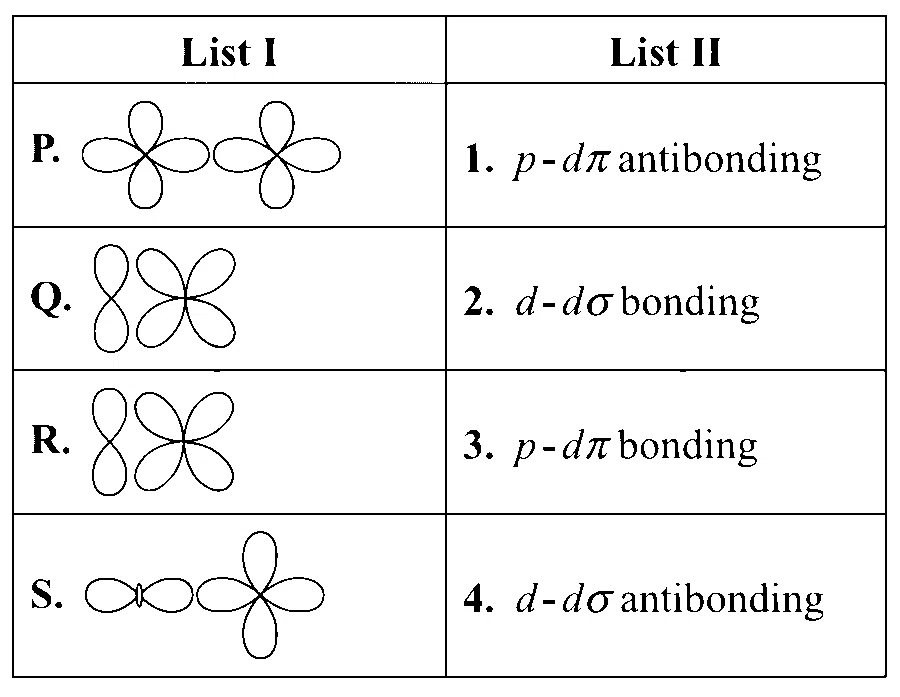
Match the orbital overlap figures shown in List I with the description given in List II and select the correct answer using the code given below the lists.

JEE Advanced · 25 May 2014 · Answers and step-by-step solutions
Showing 25 of 60 questions · Page 2 of 3
Match the orbital overlap figures shown in List I with the description given in List II and select the correct answer using the code given below the lists.
X and Y are two volatile liquids with molar weights of 10 g mol
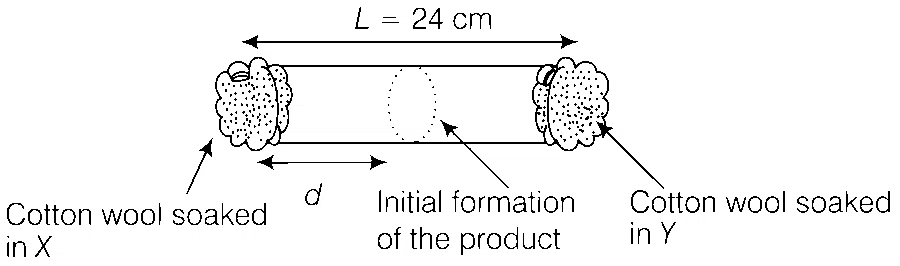
X and Y are two volatile liquids with molar weights of 10 g mol
The experimental value of d is found to be smaller than the estimate obtained using Graham's law. This is due to
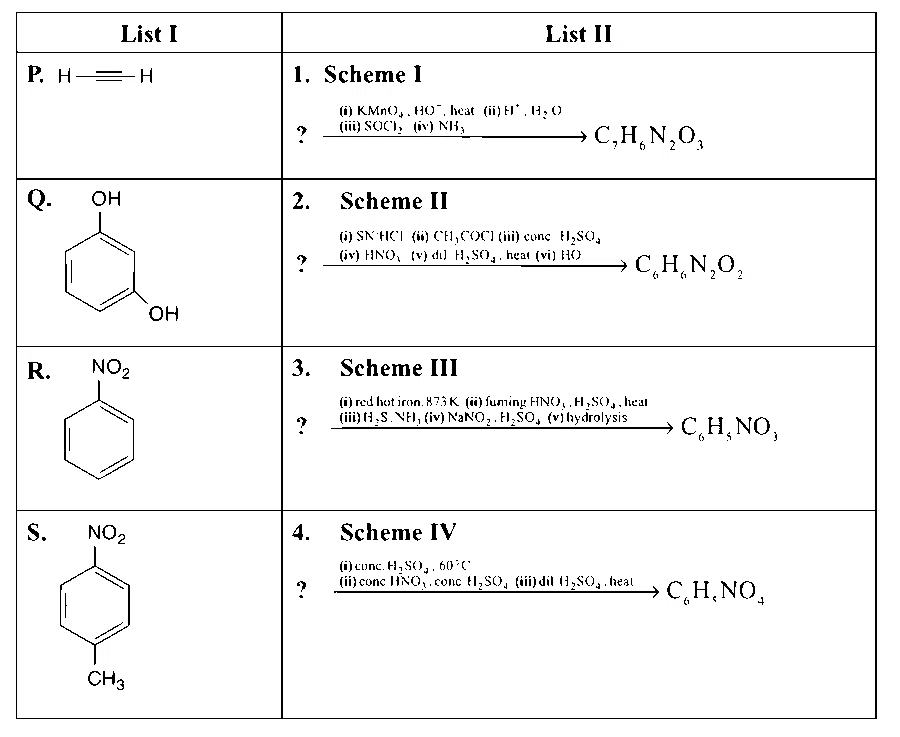
Match the four starting materials (P, Q, R, S) given in List I with the corresponding reaction schemes (I, II, III, IV) provided in List II and select the correct answer using the code given below the lists.
Match each coordination compound in List I with an appropriate pair of characteristics from List II and select the correct answer using the code given below the lists.
{en = H2NCH2CH2NH2; atomic numbers : Ti = 22, Cr = 24; Co = 27; Pt = 78}
| List I | List II | ||
|---|---|---|---|
| P. | 1. | Paramagnetic and exhibits ionisation isomerism. | |
| Q. | 2. | Diamagnetic and exhibits cis-trans isomerism. | |
| R. | 3. | Paramagnetic and exhibits cis-trans isomerism. | |
| S. | 4. | Diamagnetic and exhibits ionisation isomerism. |
Schemes 1 and 2 describe sequential transformation of alkynes M and N. Consider only the major products formed in each step for both the schemes.
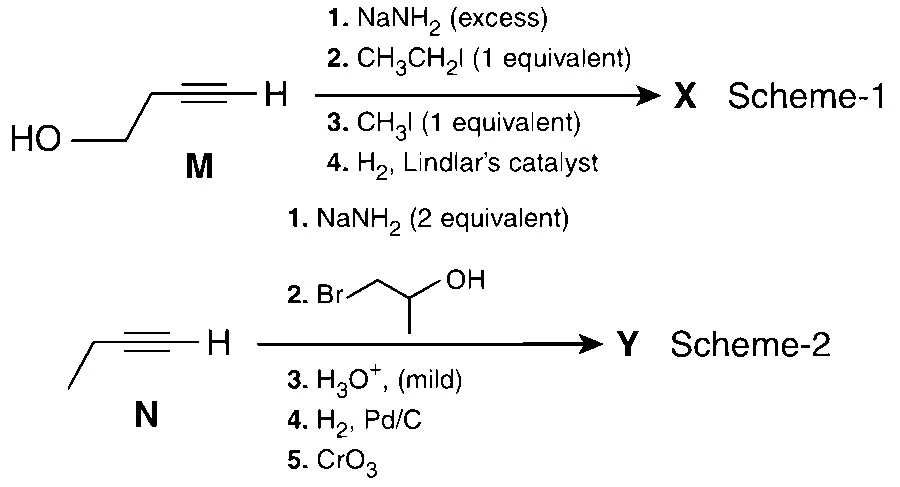
Schemes 1 and 2 describe sequential transformation of alkynes M and N. Consider only the major products formed in each step for both the schemes.
The correct statement with respect to product Y is
The product formed in the reaction of SOCl2 with white phosphorus is
Under ambient conditions, the total number of gases released as products in the final step of the reaction scheme shown below is
An aqueous solution of metal ion M1 reacts separately with reagents Q and R in excess to give tetrahedral and square planar complexes, respectively. An aqueous solution of another metal ion M2 always forms tetrahedral complexes with these reagents. Aqueous solution of M2 on reaction with reagent S gives white precipitate which dissolves in excess of S. The reactions are summarised in the scheme given below:
SCHEME:
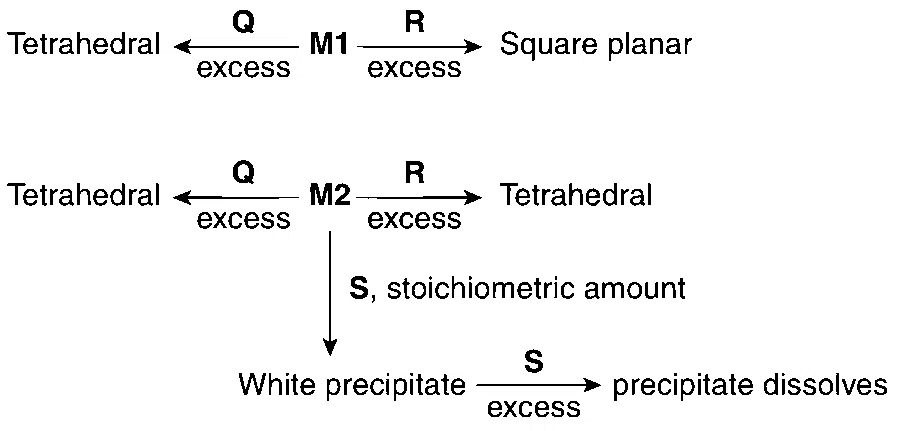
An aqueous solution of metal ion M1 reacts separately with reagents Q and R in excess to give tetrahedral and square planar complexes, respectively. An aqueous solution of another metal ion M2 always forms tetrahedral complexes with these reagents. Aqueous solution of M2 on reaction with reagent S gives white precipitate which dissolves in excess of S. The reactions are summarised in the scheme given below:
SCHEME:
Reagent S is
List-I
List-II
The value of
The value of
List
1.
2.
3.
4.
f2(x) = x2 ;
and
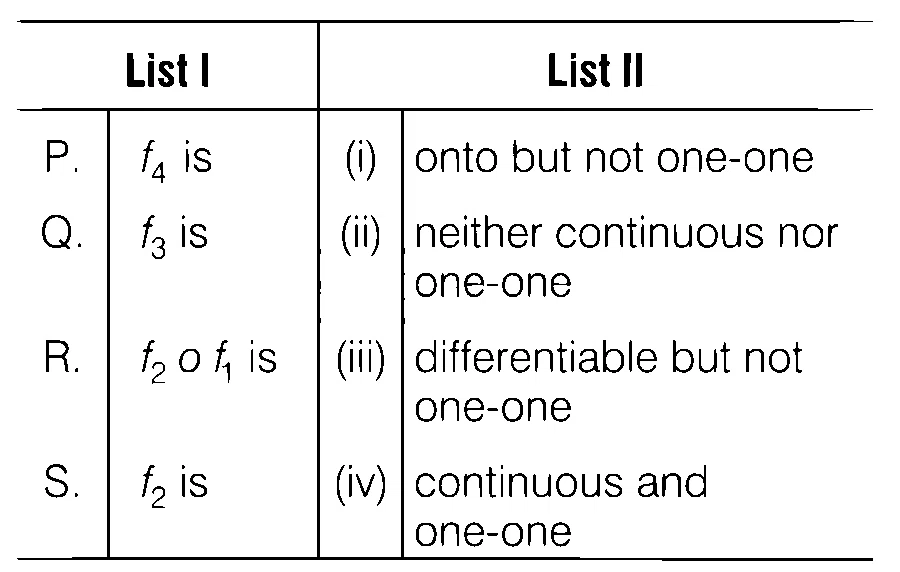
(P.)
(Q.)
(R.)\)
(S.)\)
\)
(1.)\)
(2.)\)
(3.)\)
(4.)\)