PracBee
Back

IIT-JEE 2007 Paper 1 Offline Question Paper

JEE Advanced · 8 Apr 2007 · Answers and step-by-step solutions

Paper PDF and print

Showing 25 of 66 questions · Page 2 of 3

26IIT-JEE 2007 Paper 1 Offline
MCQ+3 / -12007Chemistry

Among the following the paramagnetic compound is:

27IIT-JEE 2007 Paper 1 Offline
MCQ+3 / -12007Chemistry

Statement 1 : Boron always forms covalent bond.


Statement 2 : The small size of B3+ favours formation of covalent bond.

28IIT-JEE 2007 Paper 1 Offline
MCQ+3 / -12007Chemistry

Match the complexes in Column I with their properties listed in Column II. Indicate your answer by darkening the appropriate bubbles of the 4 × 4 matrix given in the ORS.


Column IColumn II
(A)[Co(NH3)4(H2O)2]Cl2(P)geometrical isomers
(B)[Pt(NH3)2Cl2](Q)paramagnetic
(C)[Co(H2O)5Cl]Cl(R)diamagnetic
(D)[Ni(H2O)6]Cl2(S)metal ion with +2 oxidation state

29IIT-JEE 2007 Paper 1 Offline
MCQ+3 / -12007Chemistry

Chemical reactions involve interaction of atoms and molecules. A large number of atoms/molecules (approximately 6.023 × 10²³) are present in a few grams of any chemical compound varying with their atomic/molecular masses. To handle such large numbers conveniently, the mole concept was introduced. This concept has implications in diverse areas such as analytical chemistry, biochemistry, electrochemistry and radiochemistry. The following example illustrates a typical case, involving chemical/electrochemical reaction, which requires a clear understanding of the mole concept. A 4.0 molar aqueous solution of NaCl is prepared and 500 mL of this solution is electrolysed. This leads to the evolution of chlorine gas at one of the electrodes (atomic mass : Na = 23, Hg = 200; 1 Faraday = 96500 coulombs)

The total number of moles of chlorine gas evolved is :

30IIT-JEE 2007 Paper 1 Offline
MCQ+3 / -12007Chemistry

Chemical reactions involve interaction of atoms and molecules. A large number of atoms/molecules (approximately 6.023 × 10²³) are present in a few grams of any chemical compound varying with their atomic/molecular masses. To handle such large numbers conveniently, the mole concept was introduced. This concept has implications in diverse areas such as analytical chemistry, biochemistry, electrochemistry and radiochemistry. The following example illustrates a typical case, involving chemical/electrochemical reaction, which requires a clear understanding of the mole concept. A 4.0 molar aqueous solution of NaCl is prepared and 500 mL of this solution is electrolysed. This leads to the evolution of chlorine gas at one of the electrodes (atomic mass : Na = 23, Hg = 200; 1 Faraday = 96500 coulombs)

If the cathode is a Hg electrode, the maximum weight (g) of amalgam formed from this solution is:

31IIT-JEE 2007 Paper 1 Offline
MCQ+3 / -12007Chemistry

Chemical reactions involve interaction of atoms and molecules. A large number of atoms/molecules (approximately 6.023 × 10²³) are present in a few grams of any chemical compound varying with their atomic/molecular masses. To handle such large numbers conveniently, the mole concept was introduced. This concept has implications in diverse areas such as analytical chemistry, biochemistry, electrochemistry and radiochemistry. The following example illustrates a typical case, involving chemical/electrochemical reaction, which requires a clear understanding of the mole concept. A 4.0 molar aqueous solution of NaCl is prepared and 500 mL of this solution is electrolysed. This leads to the evolution of chlorine gas at one of the electrodes (atomic mass : Na = 23, Hg = 200; 1 Faraday = 96500 coulombs)

The total charge (coulombs) required for complete electrolysis is:

32IIT-JEE 2007 Paper 1 Offline
MCQ+3 / -12007Chemistry

Match gases under specified conditions listed in Column I with their properties/laws in Column II. Indicate your answer by darkening the appropriate bubbles of the 4 × 4 matrix given in the ORS.


Column IColumn II
(A)hydrogen gas (P = 200 atm, T = 273 K)(P)Compressibility factor ≠ 1
(B)hydrogen gas (P ∼ 0, T = 273 K)(Q)attractive forces are dominant
(C)CO2 (P = 1 atm, T = 273 K)(R)PV = nRT
(D)real gas with very large molar volume(S)P(V−nb)=nRT

33IIT-JEE 2007 Paper 1 Offline
MCQ+3 / -12007Chemistry

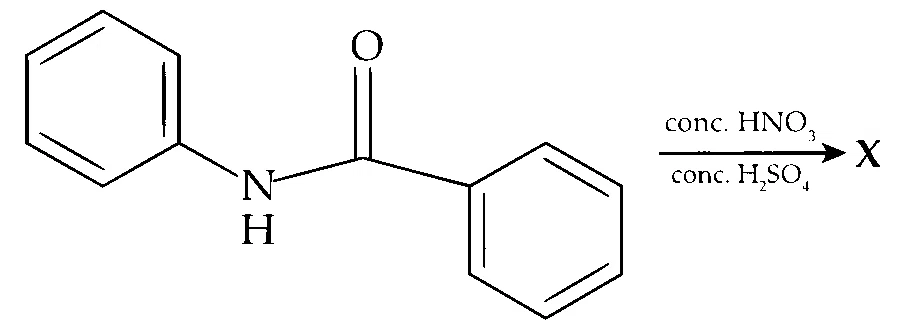
In the following reaction,


IIT-JEE 2007 Paper 1 Offline Chemistry - Hydrocarbons Question 8 English


The structure of the major 'X' is

34IIT-JEE 2007 Paper 1 Offline
MCQ+3 / -12007Chemistry

The reagent(s) for the following conversion,


IIT-JEE 2007 Paper 1 Offline Chemistry - Hydrocarbons Question 7 English

35IIT-JEE 2007 Paper 1 Offline
MCQ+3 / -12007Chemistry

Extraction of zinc from zinc blende is achieved by

36IIT-JEE 2007 Paper 1 Offline
MCQ+3 / -12007Chemistry

The percentage of p-character in the orbitals forming P-P bonds in P4 is

37IIT-JEE 2007 Paper 1 Offline
MCQ+3 / -12007Chemistry

Statement 1 : In water, orthoboric acid behaves as a weak monobasic acid.


Statement 2 : In water, orthoboric acid acts as a proton donor.

38IIT-JEE 2007 Paper 1 Offline
MCQ+3 / -12007Chemistry

The noble gases have closed-shell electronic configuration and are monoatomic gases under normal conditions. The low boiling points of the lighter noble gases are due to weak dispersion forces between the atoms and the absence of other interatomic interactions. The direct reaction of xenon with fluorine leads to a series of compounds with oxidation numbers +2, +4 and +6. XeF4 reacts violently with water to give XeO3. The compounds of xenon exhibit rich stereochemistry and their geometries can be deduced considering the total number of electron pairs in the valence shell.

Argon is used in arc welding because of its

39IIT-JEE 2007 Paper 1 Offline
MCQ+3 / -12007Chemistry

The noble gases have closed-shell electronic configuration and are monoatomic gases under normal conditions. The low boiling points of the lighter noble gases are due to weak dispersion forces between the atoms and the absence of other interatomic interactions. The direct reaction of xenon with fluorine leads to a series of compounds with oxidation numbers +2, +4 and +6. XeF4 reacts violently with water to give XeO3. The compounds of xenon exhibit rich stereochemistry and their geometries can be deduced considering the total number of electron pairs in the valence shell.

The structure of XeO3

40IIT-JEE 2007 Paper 1 Offline
MCQ+3 / -12007Chemistry

The noble gases have closed-shell electronic configuration and are monoatomic gases under normal conditions. The low boiling points of the lighter noble gases are due to weak dispersion forces between the atoms and the absence of other interatomic interactions. The direct reaction of xenon with fluorine leads to a series of compounds with oxidation numbers +2, +4 and +6. XeF4 reacts violently with water to give XeO3. The compounds of xenon exhibit rich stereochemistry and their geometries can be deduced considering the total number of electron pairs in the valence shell.

XeF4 and XeF6 are expected to be

41IIT-JEE 2007 Paper 1 Offline
MCQ+3 / -12007Chemistry

Match the chemical substances in Column I with type of polymers/type of bonds in Column II. Indicate your answer by darkening the appropriate bubbles of the 4 × 4 matrix given in the ORS.


Column IColumn II
(A)cellulose(P)natural polymer
(B)nylon-6, 6(Q)synthetic polymer
(C)protein(R)amide linkage
(D)sucrose(S)glycoside linkage

42IIT-JEE 2007 Paper 1 Offline
MCQ+3 / -12007Chemistry

When 20 g of naphthoic acid (C11H8O2) is dissolved in 50 g of benzene in 50 g of benzene (Kf = 1.72 K kg mol−1), a freezing point depression of 2 K is observed. The van't Hoff factor (i) is :

43IIT-JEE 2007 Paper 1 Offline
MCQ+3 / -12007Chemistry

Statement 1 : Micelles are formed by surfactant molecules above the critical micellar concentration (CMC).


Statement 2 : The conductivity of a solution having surfactant molecules decreases sharply at the CMC.

44IIT-JEE 2007 Paper 1 Offline
MCQ+3 / -12007Chemistry

The value of log10 K for a reaction A⇌B is


(Given : ΔrH298K∘=−54.07 kJ mol−1, ΔrS298K∘=10 J K−1 mol−1 and R = 8.314 J K−1 mol−1; 2.303 × 8.314 × 298 = 5705)

45IIT-JEE 2007 Paper 1 Offline
MCQ+3 / -12007Mathematics

Let f(x) be differentiable on the interval (0, ∞) such that f(1)=1, and limt→x⁡t2f(x)−x2f(t)t−x=1 for each x>0. Then f(x) is

46IIT-JEE 2007 Paper 1 Offline
MCQ+3 / -12007Mathematics

Tangents are drawn from the point (17, 7) to the circle x2+y2=169.


Statement 1 : The tangents are mutually perpendicular.


Statement 2 : The locus of the points from which mutually perpendicular tangents can be drawn to the given circle is x2+y2=338

47IIT-JEE 2007 Paper 1 Offline
MCQ+3 / -12007Mathematics

A man walks a distance of 3 units from the origin towards the north-east (N 45∘E) direction. From there, he walks a distance of 4 units towards the north-west (N 45∘W) direction to reach a point P. Then the position of P in the Argand plane is

48IIT-JEE 2007 Paper 1 Offline
MCQ+3 / -12007Mathematics

limx→π4⁡∫2sec2xf(t)dtx2−π216 equal

49IIT-JEE 2007 Paper 1 Offline
MCQ+3 / -12007Mathematics

Match the integrals in Column I with the values in Column II.


Column IColumn II
(A)∫−11dx1+x2(P)12log⁡(23)
(B)∫01dx1+x2(Q)2log⁡(23)
(C)∫23dx1+x2(R)π3
(D)∫12dxxx2−1(S)π2

50IIT-JEE 2007 Paper 1 Offline
MCQ+3 / -12007Mathematics

A hyperbola, having the transverse axis of the length 2sin⁡θ, is confocal with the ellipse 3x2+4y2=12. Then its equation is

More 2007 JEE Advanced papers