26COMEDK 2024 Evening Shift
MCQ+1 / -02024Chemistry
Which of the following 2 compounds exhibit both Geometrical and Structural isomerism?

COMEDK · 12 May 2024 · Answers and step-by-step solutions
PDF and print include all subjects in this paper.
Showing 25 of 60 Chemistry questions · Page 2 of 3
Which of the following 2 compounds exhibit both Geometrical and Structural isomerism?
Based on Valence Bond Theory, match the complexes listed in Column I with the number of unpaired electrons on the central metal ion, given in Column II
| No. | Complex ions | No. | Number of unpaired electrons |
|---|---|---|---|
| (A) | (P) | 0 | |
| (B) | (P) | 1 | |
| (C) | (R) | 5 | |
| (D) | (S) | 4 |
Based on Crystal Field theory, match the Complex ions listed in Column I with the electronic configuration in the d orbitals of the central metal ion listed in Column II.
| No. | Complexion | No. | d orbital configuration of central metal ion. |
|---|---|---|---|
| (A) | (P) | ||
| (B) | (Q) | ||
| (C) | (R) | ||
| (D) | (S) |
Given below are 4 statements. Two of these are correct statements. Identify them.
A.
B.
C. Removal of
D. Crystal Field splitting in Octahedral and Tetrahedral complexes is given by the equation
An inorganic compound
Z appears in the form of orange crystals and is used as an oxidising agent in acid medium. Identify the compound W.
The Lanthanoid ion which would form coloured compounds is -------------.
Atomic numbers:
Identify the correct statement from the following.
Identify the correct statement regarding corrosion of iron rod left exposed to atmosphere.
A dry cell consists of a moist paste of
Given below are 2 statements: Assertion and Reason. Choose the correct option.
Assertion: When Molar conductivity for a strong electrolyte is plotted versus
Reason: At infinite dilution, strong electrolytes of the same type will have different number of ions due to incomplete dissociation.
Arrange the following redox couples in the increasing order of their reducing strength:
A current of 3.0A is passed through 750 ml of 0.45 M solution of CuSO
What is the quantity of charge, in Faraday units, required for the reduction of 3.5 moles of
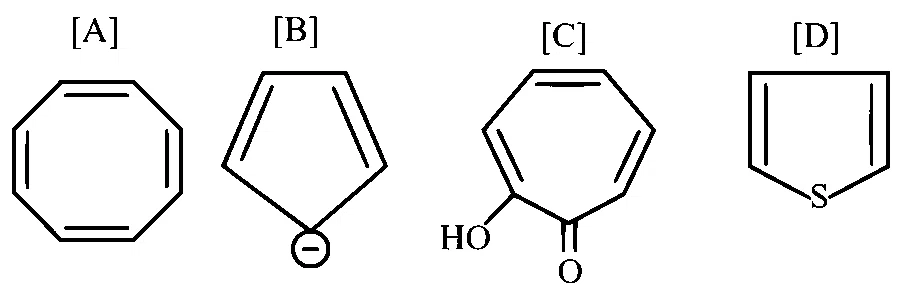
Identify the compound which is non-aromatic in nature.
Identify the final product formed when Toluene undergoes a series of reactions with reagents given in the order:
(i)
(ii)
(iii) Acetophenone /
Arrange the compounds
Match the names of reactions given in Column I with the appropriate reactions given in Column II.
| No. | Name of reaction | No. | Equations representing reactions |
|---|---|---|---|
| (A) | Sandmeyer | (P) | |
| (B) | Fittig | (Q) | |
| (C) | Swarts | (R) | |
| (D) | Finkelstein | (S) |
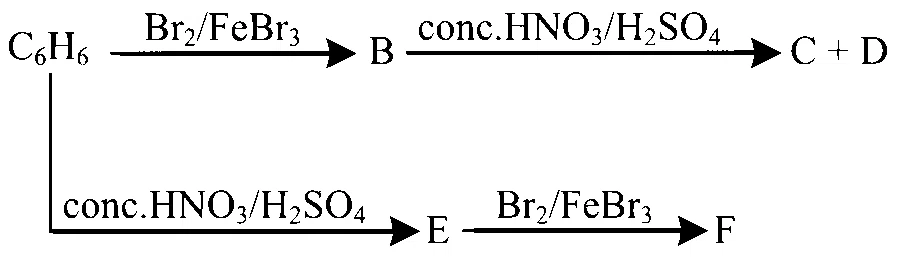
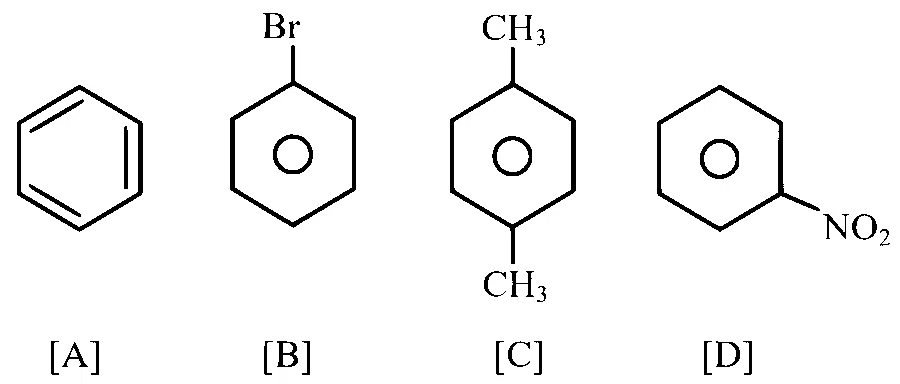
Identify the products C, D and F formed in the following sets of reactions.
Arrange the following compounds in the increasing order of their reactivity when each of them is reacted with chloroethane / anhydrous AlCl
A Hydrocarbon [A] (molecular formula
Given below are 4 reactions. Two of these reactions will give product which is an equimolar mixture of the d and 1 forms. Identify these 2 reactions.
[A] 2- Methylpropene +
[B] But-1-ene +
[C] 3-Methylbut-1-ene +
[D] 3- Phenylpropene +
Identify the product
1,1,2,2- Tetrabromopropane + 2
What volume of
A solute