26BITSAT 2022
MCQ+3 / -12022Physics
In a resonance coloum first and second resonance are obtained at depths 24 cm and 78 cm the third resonance will be obtained at depth.

Showing 25 of 120 questions · Page 2 of 5
In a resonance coloum first and second resonance are obtained at depths 24 cm and 78 cm the third resonance will be obtained at depth.
A submarine A travelling at 17 m/s is being chased along the line of its velocity by another submarine B travelling at 34 m/s. B sends a sonar signal of 600 Hz to detect A and receives a reflected sound of frequency
[Speed of sound in water = 1500 ms
Transverse waves of the same frequency are generated in two steel wires A and B. The diameter of A is twice that of B and the tension in A is half that in B. The ratio of the velocities of the waves in A and B is
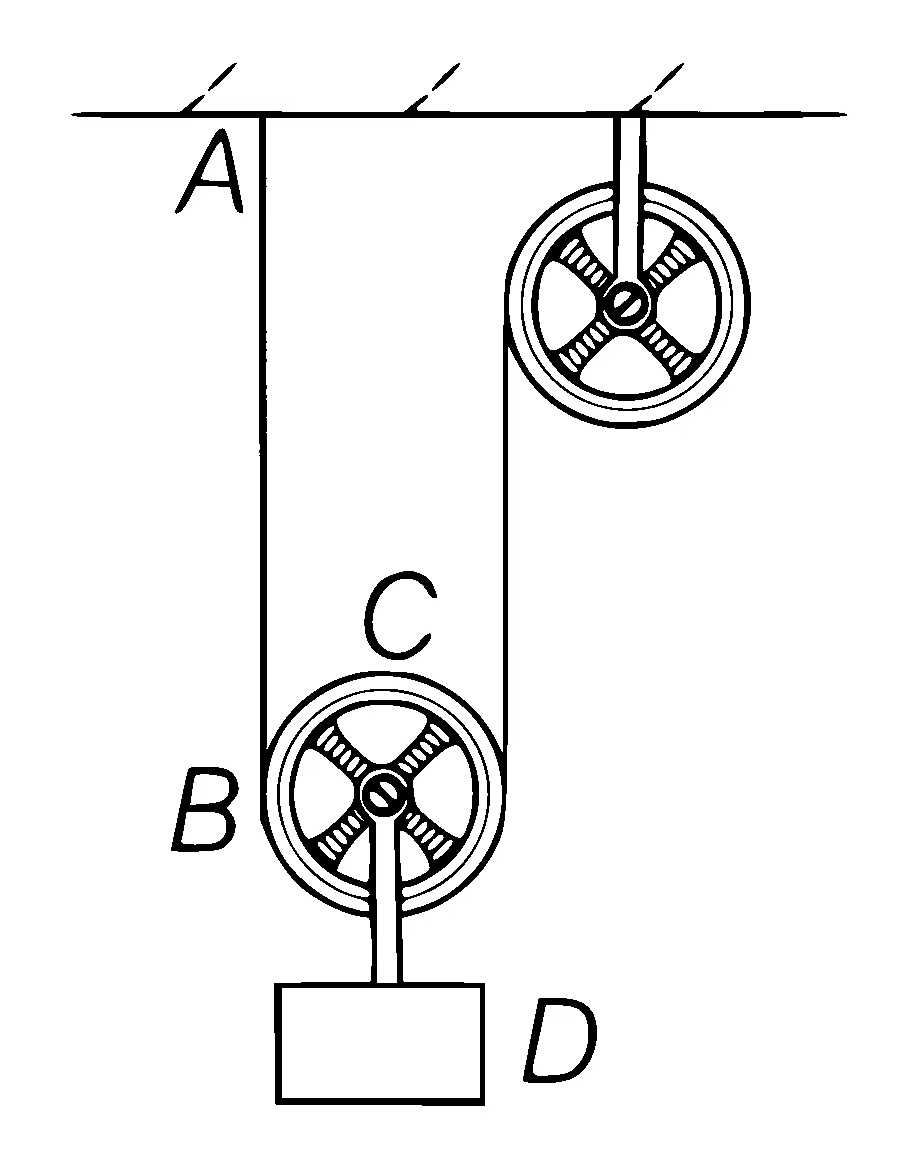
In the diagram shown below, both the strings AB and CD are made of same material and have same cross-section. The pulleys are light and fictionless. If the speed of wave in string AB is v1 and in CD is v2, then
A machine gun fires 300 bullets per min if the mass of each bullet is 10 g and the velocity of the bullets is 600 ms
Which one of the following statements in relation to the hydrogen atom is correct?
Glucose reacts with X number of molecules of phenyl hydrazine to yield osazone. The value of X is,
OF and F2 can be compared in terms of
The structure of H2O2 is
In which pair or pairs is the stronger bond found in the first species?
I. O
In the molecules CH4, NF3, NH
What is [NH
For an isomerisation reaction A
loge K = 4.0
The value of
Ninhydrin gives yellow colour in paper chromatography with which amino acid?
What is the hybridisation of [CrF6]3
Select the correct statement about the complex [Co(NH3)5SO4] Br.
Using the standard electrode potential, find out the pair between which redox reaction is not feasible.
E
Match the species in Column I with their types in Column II.
| Column I | Column II | ||
|---|---|---|---|
| A. | DDT | 1. | Photochemical smog |
| B. | NaClO | 2. | Disinfectant |
| C. | Cl | 3. | Herbicides |
| D. | PAN | 4. | Pesticides |

X and Y are
The reaction of C6H5CH = CHCH3 with HBr produces
Which one of the following is correct order of given isotopes?
I. T2 > D2 > P2 (order of boiling point)
II. T2 > D2 > P2 (order of bond energy)
III. T2 = D2 = P2 (order of bond length)
IV. T2 < D2 < P2 (order of reactivity with Cl2)
ortho and para form of hydrogen have
100 mL of 2 M of formic acid (pKa = 3.74) is neutralise by NaOH, at the equivalence point pH is
Ge (II) compounds are powerful reducing agents whereas Pb (IV) compounds are strong oxidants. It can be because
The number of 3C